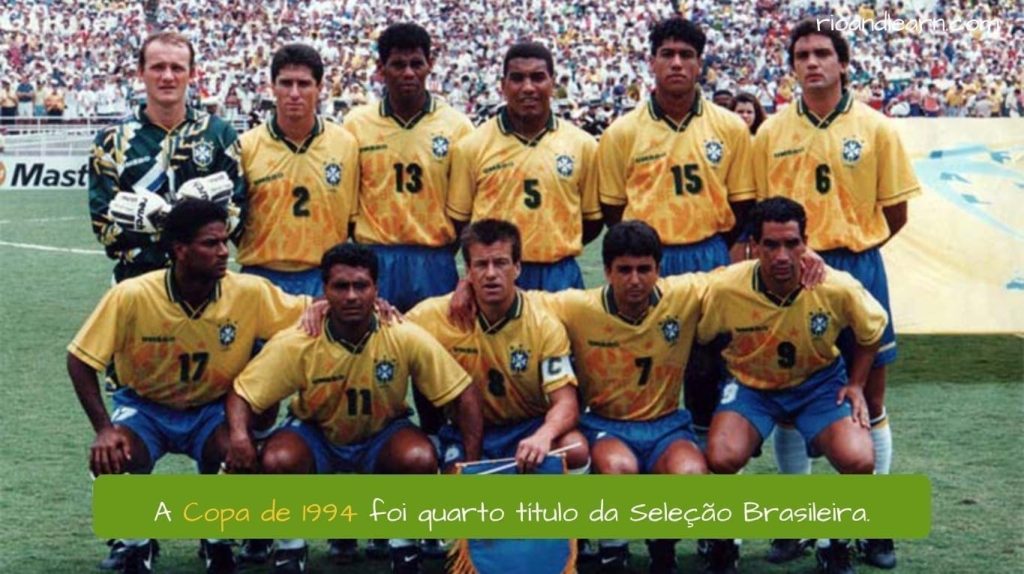

What’s up, galera! Today we are going back to Brazil 1994, one of the most important World Cup stories in Brazilian football. This was the tournament where the Seleção ended a 24-year wait, beat Italy in a dramatic final, and became tetracampeão, four-time World Cup champion.
In this Dica, we will talk about Romário, Bebeto, Dunga, Ronaldo Nazário, coach Carlos Alberto Parreira, and the unforgettable penalty shootout.
Brazil’s Journey Through the 1994 World Cup
| Stage | Match | Score |
| Group Stage | Brazil vs Russia | 2–0 |
| Group Stage | Brazil vs Cameroon | 3–0 |
| Group Stage | Brazil vs Sweden | 1–1 |
| Round of 16 | Brazil vs United States | 1–0 |
| Quarter-final | Brazil vs Netherlands | 3–2 |
| Semi-final | Brazil vs Sweden | 1–0 |
| Final | Brazil vs Italy | 0–0 |
| Penalties | Brazil vs Italy | 3–2 |
Brazil 1994: A Different Kind of Brazilian Champion
The 1994 World Cup was hosted in the United States from June 17 to July 17, 1994. For Brazil, though, the tournament was about much more than a new host country. After 24 years without a World Cup title, the Seleção arrived under huge pressure to return to the top.
The 1994 team had a different style. Parreira’s Brazil was compact, disciplined, and more careful than the romantic Brazilian teams of the past. Some fans criticized the team for being too defensive, but others saw it as exactly what Brazil needed after years of frustration.
With Dunga organizing the midfield, Mauro Silva protecting the defense, Taffarel bringing calm in goal, and Romário and Bebeto deciding games up front, Brazil found a new formula. Less espetáculo, more control. Less risk, more consistency.
Groups and Countries
| Group A | Group B | Group C |
| Romania | Brazil | Germany |
| Switzerland | Russia | Spain |
| United States | Sweden | South Korea |
| Colombia | Cameroon | Bolivia |
| Group D | Group E | Group F |
| Nigeria | Mexico | Netherlands |
| Bulgaria | Republic of Ireland | Saudi Arabia |
| Argentina | Italy | Belgium |
| Greece | Norway | Morocco |
The 1994 World Cup had six groups, with 24 countries in total. One important change was the points system: for the first time in World Cup history, teams received three points for a win instead of two. This encouraged teams to attack more and made group-stage victories even more valuable.
Problems Before the World Cup
Before the tournament, Brazil had serious tension around Romário. He was one of the best Brazilian players in the world, but he did not have an easy relationship with coach Carlos Alberto Parreira and his staff during qualification.
In the final qualifying match against Uruguay, Brazil needed to win to secure its place at the 1994 World Cup. Under pressure, Parreira called Romário back into the team. Romário was having a great season at Barcelona, and he showed exactly why Brazil needed him: he scored twice, Brazil won, and the Seleção was going to the United States.
Let’s see it:
Romário became Brazil’s most important player at the 1994 World Cup, scoring five goals in seven matches.
Brazil x Italy in 1994
The 1994 FIFA World Cup final took place on July 17, 1994, at the Rose Bowl in Pasadena, California. Brazil and Italy met in a World Cup final again, 24 years after Brazil’s famous 4-1 victory in 1970.
This time, the match was much tighter. After 120 minutes without a goal, the final went to penalties. It was the first World Cup final ever decided this way.
Baggio’s Missed Penalty and Brazil’s Fourth Title
Brazil had already seen Márcio Santos miss his penalty, but Taffarel saved Daniele Massaro’s shot and kept Brazil alive. Then Romário, Branco, and Dunga scored for Brazil.
The final moment came with Roberto Baggio, Italy’s biggest star. He needed to score to keep Italy in the shootout, but his penalty went over the crossbar. In one second, Baggio became part of World Cup heartbreak, and Brazil became tetracampeão.
For Brazilians, that image is unforgettable: Baggio looking down, the ball flying high, and the Seleção celebrating its fourth World Cup title after 24 years of waiting.
Let’s see how that was:
Remember, you can also enjoy Brazilian football culture here in Rio with us! Our student visa can help you spend some time here while you study Portuguese!
Brazil 1994 World Cup Team Players
Just like Pelé in the 1958 World Cup, Ronaldo was part of the Brazil squad at only 17 years old. He did not play in the tournament, but he experienced the World Cup atmosphere and got ready for the tournaments still to come. But this does not mean the 1994 Brazil team was weak, oh no! The squad was full of names that became part of football history.
| 1 | Goleiro | Taffarel |
| 2 | Lateral direito | Jorginho |
| 3 | Zagueiro | Ricardo Rocha |
| 4 | Zagueiro | Ronaldão |
| 5 | Meio-campo | Mauro Silva |
| 6 | Lateral esquerdo | Branco |
| 7 | Atacante | Bebeto |
| 8 | Meio-campo | Dunga |
| 9 | Meia | Zinho |
| 10 | Meia | Raí |
| 11 | Atacante | Romário |
| 12 | Goleiro | Zetti |
| 13 | Zagueiro | Aldair |
| 14 | Lateral direito | Cafu |
| 15 | Zagueiro | Márcio Santos |
| 16 | Lateral esquerdo | Leonardo |
| 17 | Meio-campo | Mazinho |
| 18 | Meia | Paulo Sérgio |
| 19 | Atacante | Müller |
| 20 | Atacante | Ronaldo |
| 21 | Atacante | Viola |
| 22 | Goleiro | Gilmar |
Romário and Bebeto: Brazil’s Decisive Duo
If Brazil in 1994 was built on discipline, Romário and Bebeto were the magic up front.
Romário was the main star of the team. Quick, clever, and deadly inside the box, he scored five goals in the tournament and gave Brazil the confidence it needed in difficult moments. Bebeto brought movement, intelligence, and calm finishing. Together, they gave Brazil exactly what a compact team needs: attackers who do not waste chances.
Their partnership was one of the biggest reasons Brazil became champion. When the midfield kept things organized and the defense stayed solid, Romário and Bebeto were there to decide the game.
And of course, Bebeto also gave us one of the most famous celebrations in World Cup history. After scoring against the Netherlands, he celebrated by rocking his arms like he was holding a baby, a tribute to his newborn son. Romário and Mazinho joined him, and the celebration became an unforgettable image of Brazil’s 1994 World Cup.
The Personal Crisis Behind Romário’s World Cup
Romário’s 1994 story also had a frightening personal chapter. Just before the World Cup, his father, Edevair de Souza Faria, was kidnapped in Rio de Janeiro. The case shocked Brazil and created real doubt about whether Romário would travel to the United States for the tournament.
Romário reportedly said he would not play the World Cup if his father was not released. After several tense days, Edevair was freed, and Romário returned to football with even more attention on him.
Dunga: The Captain Who Divided Opinion
Dunga was one of the most important symbols of Brazil in 1994. He was the captain, the leader in midfield, and the player who represented a more disciplined version of the Seleção.
For some Brazilian fans, this was difficult to accept. After years of celebrating technical, creative players, Dunga did not always look like the classic Brazilian football star. He was not there to dribble past everyone or create beautiful attacking moves. His job was to organize, fight, protect the defense, and give balance to the team.
That made him a controversial figure. Some people criticized him, saying he did not have the same flair as other Brazilian players. But in 1994, his consistency became essential. With Dunga and Mauro Silva controlling the midfield, Brazil became harder to beat.
And when Brazil won the final against Italy, Dunga also scored one of the penalties in the shootout. For a captain who had heard so much criticism, lifting the World Cup trophy was the perfect answer.
Important Highlights During the 1994 World Cup
Maradona’s Doping Scandal: Diego Maradona, one of football’s greatest players, was sent home from the tournament after failing a drug test. He tested positive for ephedrine, a banned substance. Maradona argued that he ingested the substance unknowingly, but his expulsion still marked a controversial end to his World Cup career.
Andrés Escobar’s Tragic Death: Colombian defender Andrés Escobar scored an own goal during a group-stage match against the United States, contributing to Colombia’s elimination from the tournament. Tragically, after returning to Colombia, Escobar was shot and killed in Medellín. His death became one of the darkest stories connected to the pressure around football.
Hristo Stoichkov and Oleg Salenko’s Golden Boot: Bulgaria’s Hristo Stoichkov and Russia’s Oleg Salenko finished as the tournament’s top scorers, with six goals each. Stoichkov helped Bulgaria reach the semifinals, while Salenko made history by scoring five goals in one match against Cameroon.
First World Cup in the USA: The 1994 World Cup was the first time the tournament was held in the United States. It was a significant event for the growth of football in the country and played a role in popularizing the sport there.
Now it’s your turn!
How about a quick exercise? Answer the questions according to the Dica:
- Onde foi realizada a Copa do Mundo de 1994?
- Por que Romário não havia sido convocado?
- Havia mais seleções da América do Sul além do Brasil nas quartas de final?
- Contra quem o Brasil jogou a final?
- O que de especial aconteceu na final?
That’s it! We learned about Brazil 1994, the World Cup that gave the Seleção its fourth title and made Brazil tetracampeão. What did you think about the Brazil x Italy final during the 1994 World Cup? Which player was your favorite from the 1994 Brazil team? Stay tuned for more Dicas by subscribing to A Dica do Dia or following us on Pinterest.
Bye, bye!
Hugs from Rio & Learn!
Click on the links below and see more related Dicas
Brazil 1982: Best Team Ever
2002 World Cup
1970 World Cup
1962 World Cup
Answers
- Estados Unidos
- Ele não tinha uma boa relação com o treinador da seleção brasileira.
- Não. O Brasil foi a única seleção da América do Sul nas quartas de final.
- Itália.
- Foi a primeira final da história decidida nos pênaltis.

Online Academic Coordinator at Rio & Learn Portuguese School.
Experienced educational coordinator and teacher since 2007, adept in curriculum development, creating physical and digital educational materials, and leveraging online platforms to enhance learning outcomes
PakarPBN
A Private Blog Network (PBN) is a collection of websites that are controlled by a single individual or organization and used primarily to build backlinks to a “money site” in order to influence its ranking in search engines such as Google. The core idea behind a PBN is based on the importance of backlinks in Google’s ranking algorithm. Since Google views backlinks as signals of authority and trust, some website owners attempt to artificially create these signals through a controlled network of sites.
In a typical PBN setup, the owner acquires expired or aged domains that already have existing authority, backlinks, and history. These domains are rebuilt with new content and hosted separately, often using different IP addresses, hosting providers, themes, and ownership details to make them appear unrelated. Within the content published on these sites, links are strategically placed that point to the main website the owner wants to rank higher. By doing this, the owner attempts to pass link equity (also known as “link juice”) from the PBN sites to the target website.
The purpose of a PBN is to give the impression that the target website is naturally earning links from multiple independent sources. If done effectively, this can temporarily improve keyword rankings, increase organic visibility, and drive more traffic from search results.
