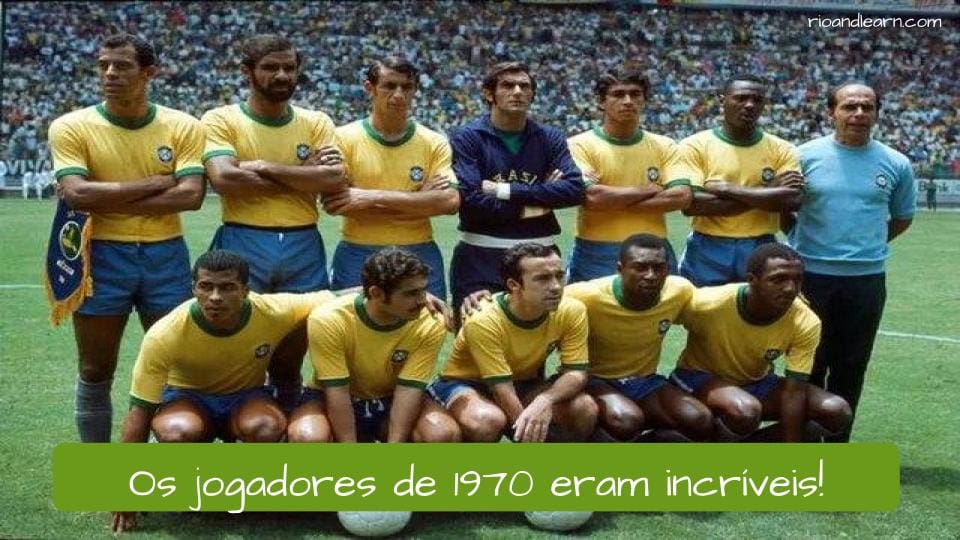

Hi guys! How are you? Today we will keep talking about football. What do you know about Brazil in the 1970 World Cup? This was Brazil’s third World Cup title, and it became one of the most famous moments in football history. The tournament was really special because Brazil’s 1970 team had legendary names like Pelé, Carlos Alberto, Jairzinho, Tostão, Gérson, and Rivelino. It was also the last World Cup with the famous Jules Rimet Trophy!
Brazil’s Journey Through the 1970 World Cup
Brazil did not just win the 1970 World Cup. Brazil won every single match, scoring 19 goals in six games and beating some huge football nations along the way. Here is Brazil’s journey to the third star.
| Stage | Match | Score |
| Group Stage | Brazil vs Czechoslovakia | 4–1 |
| Group Stage | Brazil vs England | 1–0 |
| Group Stage | Brazil vs Romania | 3–2 |
| Quarter-final | Brazil vs Peru | 4–2 |
| Semi-final | Brazil vs Uruguay | 3–1 |
| Final | Brazil vs Italy | 4–1 |
1970 World Cup and Brazil
After two consecutive World Cup titles in 1958 and 1962, Brazil tried to win its third title in 1966 but did not succeed. Four years later, the team returned even stronger. The 1970 World Cup was held in Mexico from 31 May to 21 June. It was the first World Cup staged in North America, and the first held outside Europe and South America.
Groups and Countries
| Group 1 | Group 2 |
| Soviet Union | Italy |
| Mexico | Uruguay |
| El Salvador | Israel |
| Belgium | Sweden |
| Group 3 | Group 4 |
| Brazil | West Germany |
| England | Peru |
| Romania | Bulgaria |
| Czechoslovakia | Morocco |
The New Rule
Before the 1970 World Cup, substitutions were not allowed during World Cup matches. The eleven starting players had to play the entire 90 minutes, unless a team continued with fewer players. In 1970, teams were allowed to make substitutions, which helped players physically and also improved the technical level of the games.
1970 World Cup: Facts and Curiosities
The 1970 World Cup is often remembered as the first World Cup broadcast in color, which was a huge technological step for that period. The tournament was also special because of the players who were part of Brazil’s 1970 team, including Pelé, Jairzinho, Carlos Alberto Torres, Rivelino, Gérson, and Tostão. Pelé was one of Brazil’s biggest stars, not only because of the goals he scored, but also because of the famous moments when he almost scored. Have you ever seen his long-distance shot from the middle of the field against Czechoslovakia, or the incredible header saved by Gordon Banks against England?
Brazil 1970: The Team of Five Number 10s
One of the most amazing things about Brazil in the 1970 World Cup was how many creative stars played together in the same team.
This Brazil team is often remembered as the team of five number 10s because Pelé, Tostão, Jairzinho, Rivelino, and Gérson all had the talent, technique, and intelligence usually associated with a classic number 10.
In many teams, that much talent could cause problems. Everyone wants the ball, everyone wants to decide the game, and the team can lose balance. But coach Mário Zagallo made it work.
Pelé was the great star, Tostão opened spaces, Jairzinho brought speed and goals, Rivelino added creativity and his powerful left foot, and Gérson controlled the rhythm of the midfield.
Together, they created a team full of movement, intelligence, and beauty. That is why Brazil in 1970 is still remembered as one of the greatest examples of futebol arte, or “art football,” in World Cup history.
23 Prisoners Ran Away
Among the curious stories from the 1970 World Cup, there is also the case of 23 prisoners who escaped in Mexico while the guards were distracted watching Italy vs West Germany. That match became known as one of the most exciting games in World Cup history. West Germany had already beaten England after extra time, and then they had another dramatic match against Italy. It was so tough that captain Franz Beckenbauer broke his clavicle but stayed on the pitch until the end. Although West Germany lost 4–3, that match became a legendary part of World Cup history.
Carlos Alberto Torres Goal vs Italy
Carlos Alberto Torres was another special player from Brazil. He was known for his defensive quality, leadership, and ability to support the attack. One of the most iconic moments of the 1970 World Cup came in the final against Italy, played on June 21, 1970, in Mexico City. Brazil faced Italy in the final, and Carlos Alberto scored one of the most memorable goals in World Cup history.
In the 86th minute, with Brazil leading 3–1, Carlos Alberto sealed the victory by scoring Brazil’s fourth goal. The play started with a beautiful sequence of passes involving several Brazilian players, showing the attacking flair of Brazil’s 1970 team. Pelé played a key role in the buildup, and Carlos Alberto finished the move with a powerful shot from the right side of the penalty area. This goal showed Brazil’s attacking power and Carlos Alberto’s ability to join the attack from right-back. Take a look at this amazing goal!
Pelé and the 1970 World Cup
Pelé was one of the biggest stars for Brazil in 1970, scoring four goals and creating some of the most unforgettable moments of the tournament. His influence went far beyond finishing chances. He helped organize the attack, created space for his teammates, and gave Brazil the calm and confidence of a true leader.
He scored in Brazil’s opening match against Czechoslovakia, twice against Romania, and once in the final against Italy. Pelé also helped create important goals, including the pass for Carlos Alberto’s famous goal in the final. That is why his 1970 World Cup is remembered not only for goals, but for intelligence, vision, and beautiful football.
After winning the 1970 World Cup, Brazil had to wait until the 1994 World Cup to win the tournament again. Brazil also had a great team in 1982, but the next title would only come later.
Brazil’s 1970 World Cup Team
Now, let’s check out Brazil’s 1970 squad, so you can understand how amazing this team was! And remember, if you are in Brazil, you should come visit one of the great temples of football with us: the Maracanã, during our RioLIVE! It is an amazing opportunity to learn Portuguese and experience one of the hearts of football history!
| 1 | Goleiro | Félix |
| 2 | Lateral | Carlos Alberto Torres |
| 3 | Zagueiro | Brito |
| 4 | Zagueiro | Piazza |
| 5 | Lateral | Everaldo |
| 6 | Meio campo | Gérson |
| 7 | Meio campo | Clodoaldo |
| 8 | Atacante | Pelé |
| 9 | Atacante | Jairzinho |
| 10 | Atacante | Tostão |
| 11 | Atacante | Rivelino |
| 12 | Goleiro | Aldo |
| 13 | Zagueiro | Moacir |
| 14 | Atacante | Dario |
| 15 | Atacante | Edu |
| 16 | Zagueiro | Fontana |
| 17 | Zagueiro | Joel |
| 18 | Goleiro | Leão |
| 19 | Lateral | Marco Antônio |
| 20 | Atacante | Paulo César |
| 21 | Atacante | Roberto |
| 22 | Lateral | Zé Maria |
Get to Know Brazil’s Players in 1970
Pelé: Widely regarded as one of the greatest footballers of all time, Pelé was Brazil’s biggest star in 1970. He had already won two World Cups in 1958 and 1962, and he played a crucial role in Brazil’s third title with goals, assists, leadership, and unforgettable moments.
Jairzinho: Known as “The Hurricane,” Jairzinho was one of Brazil’s most important attacking players in the 1970 World Cup. He famously scored in every match of Brazil’s campaign and brought speed, strength, and finishing power to the team.
Rivelino: An attacking midfielder known for his powerful left foot and playmaking ability, Rivelino was a key creative force in Brazil’s 1970 team. His skill and vision added even more flair to Brazil’s attacking play.
Gérson: A talented midfielder, Gérson was known for his passing ability, intelligence, and control of the game. He played a vital role in organizing Brazil’s midfield and creating chances for his teammates.
Carlos Alberto: The team captain and right-back, Carlos Alberto is famous for scoring one of the most iconic goals in World Cup history during the 1970 final against Italy. He was a strong defender, a leader, and an important part of Brazil’s attacking movement.
Clodoaldo: A midfielder, Clodoaldo helped give Brazil defensive balance and quality in the buildup. His performance in the final against Italy is especially remembered because of the beautiful dribble that helped start the move for Carlos Alberto’s famous goal.
Félix: The goalkeeper for Brazil in 1970, Félix played an important role in the team’s defensive work. While Brazil’s attacking stars often receive more attention, his contribution was also part of the team’s success.
Tostão: A forward and intelligent attacking player, Tostão formed a brilliant partnership with Pelé. He moved well, opened spaces, connected the attack, and helped Brazil play with creativity and balance.
Jules Rimet Trophy

Another important thing about the 1970 World Cup is that it was the last appearance of the Jules Rimet Trophy. The first team to win the World Cup three times could keep the trophy permanently, and Brazil, Uruguay, and Italy already had two titles before the tournament. Since 1970 was Brazil’s third World Cup title, Brazil earned the right to keep the Jules Rimet Trophy.
Pelé’s Last World Cup in 1970

The 1970 World Cup was Pelé’s last World Cup with Brazil. After the tournament, he continued playing for Santos Football Club in Brazil. Later, he moved to the United States to play for the New York Cosmos, helping make football, or soccer, more popular there. Even after leaving the Brazilian national team, Pelé remained one of the greatest names in football history, with incredible goals, titles, and three World Cup victories.
Brazil 1970 on Netflix
The story of Brazil’s 1970 World Cup team is still so powerful that it continues to inspire new productions today. Netflix recently released Brazil ’70: The Third Star, a fiction miniseries about the Brazilian national team’s journey to its third World Cup title in Mexico. The series follows names such as Pelé, Tostão, Carlos Alberto, Jairzinho, Gérson, Rivelino, and coach Zagallo, showing how this legendary team became part of Brazil’s football identity.
For anyone learning Portuguese, it is also a great chance to connect football, Brazilian history, and listening practice. After all, few stories explain Brazil’s love for football better than the 1970 World Cup.
Now it’s your turn!
Answer the questions about the 1970 World Cup using (T) for true and (F) for false:
- A copa foi sediada no México. ( )
- Foi o quarto título do Brasil. ( )
- A final foi entre Brasil e Uruguai. ( )
- As substituições foram implantadas nessa copa. ( )
- O nome do troféu é Taça Charles Muller. ( )
Alright my friends! We have just learned about Brazil’s third World Cup title in 1970, the legendary Brazilian team, and amazing players like Pelé, Jairzinho, Carlos Alberto, Tostão, Gérson, and Rivelino. Stay tuned for more Dicas by subscribing to A Dica do Dia or following us on Instagram.
See you guys!
Hugs from Rio de Janeiro!
Click on the links below to see more related Dicas
1958 World Cup
1962 World Cup
Football Vocabulary in Portuguese
Origin of Brazilian Football
Answers
- T
- F
- F
- T
- F

Online Academic Coordinator at Rio & Learn Portuguese School.
Experienced educational coordinator and teacher since 2007, adept in curriculum development, creating physical and digital educational materials, and leveraging online platforms to enhance learning outcomes
PakarPBN
A Private Blog Network (PBN) is a collection of websites that are controlled by a single individual or organization and used primarily to build backlinks to a “money site” in order to influence its ranking in search engines such as Google. The core idea behind a PBN is based on the importance of backlinks in Google’s ranking algorithm. Since Google views backlinks as signals of authority and trust, some website owners attempt to artificially create these signals through a controlled network of sites.
In a typical PBN setup, the owner acquires expired or aged domains that already have existing authority, backlinks, and history. These domains are rebuilt with new content and hosted separately, often using different IP addresses, hosting providers, themes, and ownership details to make them appear unrelated. Within the content published on these sites, links are strategically placed that point to the main website the owner wants to rank higher. By doing this, the owner attempts to pass link equity (also known as “link juice”) from the PBN sites to the target website.
The purpose of a PBN is to give the impression that the target website is naturally earning links from multiple independent sources. If done effectively, this can temporarily improve keyword rankings, increase organic visibility, and drive more traffic from search results.