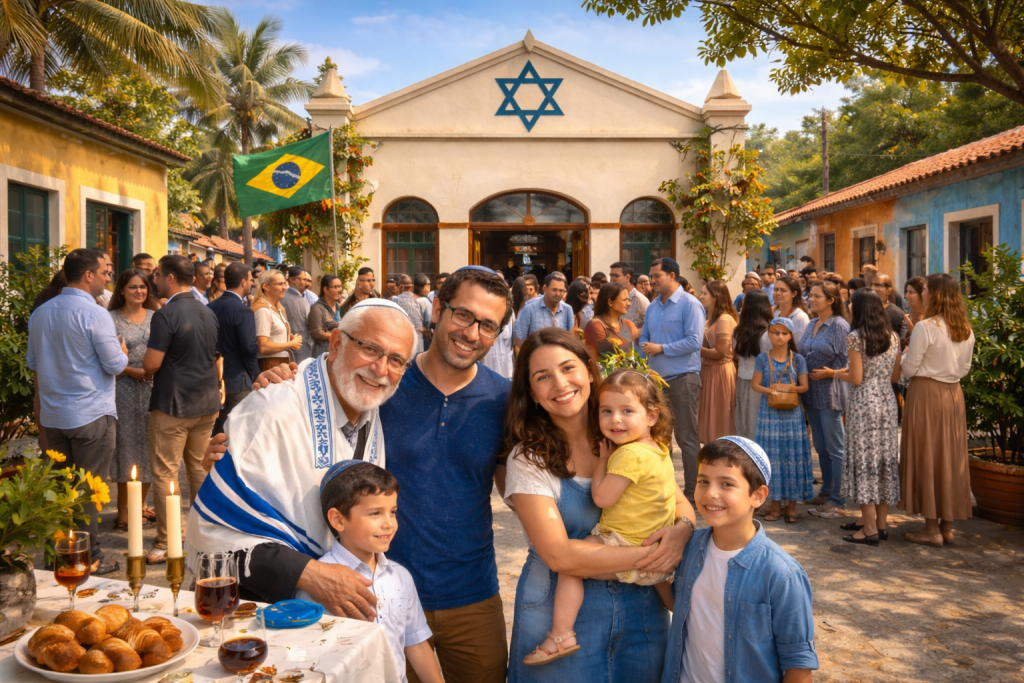

A Synagogue in the Tropics? Yes, and That’s Just the Beginning!
If someone says “Brazil,” you probably think of beaches, samba, and Carnival. But imagine this instead: 17th-century Recife, ships crossing the Atlantic, and one of the first organized Jewish communities in the Americas openly practicing their faith in a tropical port city.
Surprising? Absolutely.
The story of Jews in Brazil isn’t a footnote. It’s layered, Atlantic, emotional, and deeply connected to migration, resilience, and identity. From hidden histories during the Inquisition to powerful business families in São Paulo, from Amazon trade routes to cultural life in Rio, Jewish life in Brazil has always been part of the country’s bigger story.
Understanding that story means understanding Brazil itself.
Jews in Brazil in 60 Seconds: Who, Where, and How Many?

Let’s start with the basics.
The Jewish population in Brazil is commonly estimated at around 100,000 to 130,000 people, making it one of the largest Jewish communities in Latin America. Exact numbers vary depending on whether you’re counting self-identification, synagogue affiliation, or broader family heritage.
Where do Brazilian Jews live today?
- São Paulo is the largest center of Jewish life in Brazil.
- Rio de Janeiro also has a long-established and active community.
- Other states such as Rio Grande do Sul, Paraná, Pernambuco, Minas Gerais, Bahia, Pará, and Amazonas have historic and contemporary Jewish presence.
But numbers only tell part of the story. The Jewish community in Brazil is built around schools, cultural centers, social clubs, charitable institutions, and a strong tradition of community organization.
If you study Portuguese in Brazil, topics like migration and identity show up everywhere: in the news, in museums, in casual conversation. In our classes at Rio & Learn, students love these discussions because they feel instantly more connected to the country they’re living in.
A Timeline of Jewish Brazil: From Forced Conversions to Open Communities
Jewish history in Brazil begins earlier than many expect.
1500s: Sephardic Jews fleeing the Iberian Peninsula, including Conversos (“New Christians”), arrived in colonial Brazil. Many practiced Judaism privately under the pressures of the Inquisition.
1600s: During Dutch rule in Recife (1630–1654), Jews were able to practice openly. The synagogue Kahal Zur Israel, established in 1636, is widely regarded as the first synagogue in the Americas and marked one of the earliest organized Jewish communities in the New World.
After 1654: Portuguese control returned, and open Jewish communal life declined again.
19th century: New waves of Jewish migration began reshaping visible community life in Brazil.
20th century: Both Sephardic and Ashkenazi immigrants established enduring institutions in major Brazilian cities.
Today: Brazilian Jews participate fully in public life while maintaining strong communal structures.
This history reflects broader Brazilian themes: migration, adaptation, and negotiation of belonging.
Jewish Immigration to Brazil: The Waves That Built Today’s Communities

Sephardic roots and hidden histories
Many early Jewish stories in Brazil are tied to Iberian history. Some families carried fragments of identity through generations, sometimes quietly. It’s important to approach this history with nuance: identity in colonial Brazil was complex, and surnames alone don’t tell the whole story.
The Amazon chapter — A Distinctly Brazilian Story
Jewish migration wasn’t limited to Rio and São Paulo.
In the 19th century, Moroccan Jewish migrants settled in cities like Belém (Pará) and Manaus (Amazonas), integrating into regional trade networks during the rubber boom era. These communities established synagogues and communal institutions that still exist today.
This Amazonian chapter adds a uniquely Brazilian dimension to Jewish diaspora history: Atlantic, tropical, and connected to global commerce.
20th-century arrivals and city-building
The 20th century brought Jewish immigrants from Eastern Europe, the Middle East, and North Africa. These communities built:
- Jewish schools
- Cultural and community centers
- Charitable organizations
- Synagogues
- Social clubs
In São Paulo especially, Jewish immigrants and their descendants became part of the city’s economic and institutional development.
Famous Brazilian Jews: Influence in Business, Culture, and Public Life
Jewish life in Brazil is not only about community institutions; it’s also about public impact.
Banking and business
One of the most internationally recognized examples is the Safra family, prominent in Brazilian and global banking. Their story connects immigration, entrepreneurship, and philanthropy. More broadly, Jewish immigrants and their descendants have played visible roles in Brazilian finance and business development, especially in São Paulo.
Arts, media, and intellectual life
Brazilian Jews have also contributed to journalism, academia, literature, and the arts. These figures aren’t separate from Brazil’s national story; they’re part of it.
This is also a fun place to learn Portuguese through curiosity: reading a Brazilian biography, watching an interview, or understanding how Brazilian media frames public figures. If you want help doing that confidently, Rio & Learn group and private classes are designed to get you speaking about real topics such as culture, history, politics, and everything in between.
Where Jewish Life in Brazil Lives Today
Today, the Jewish community in Brazil remains strongest in major urban centers.
São Paulo is the largest hub, with extensive educational, religious, and cultural infrastructure. Rio de Janeiro maintains an active and historic presence. Northern communities such as those in Belém and Manaus preserve distinctive regional traditions.
This isn’t about checklist tourism. It’s about how Jewish identity lives within Brazilian society, through schools, philanthropy, civic engagement, family life, and public conversation.
Jewish life in Brazil is urban and familial, visible and deeply personal at the same time.
Culture & Daily Life: What the Brazilian Jewish Experience Feels Like From the Inside

Jewish identity in Brazil isn’t separate from Brazilian identity. It’s layered.
Family gatherings. Community events. Holiday celebrations. Conversations about origem (origin), tradição (tradition), and comunidade (community).
Portuguese shapes how identity is expressed, showing that the words matter. Even the same concept can sound more personal, more subtle, or more political depending on the phrasing.
Food can be part of that too, but not in a “tourist food tour” way. Think: family recipes, community kitchens, holiday tables, and the feeling of continuity that comes from repeating traditions in a new country.
Like Jewish communities globally, Brazilian Jews exist within broader political and social contexts.
Recent years have seen increased public discussion about antisemitism and community security. Organizations such as CONIB (Confederação Israelita do Brasil) publish annual reports documenting incidents and public responses. In 2024, the majority of reported incidents occurred online, reflecting global digital trends.
These discussions appear in Brazilian media and institutional statements, shaping how community life is understood today.
Portuguese Practice: Jewish Life in Brazil Vocabulary You’ll Actually Hear
Let’s make this practical.
Here are key Portuguese words connected to Jewish life in Brazil:
| comunidade judaica | jewish community |
| sinagoga | synagogue |
| centro cultural | cultural center |
| imigração | immigration |
| refugiado / refugiada | refugee |
| tradição | tradition |
| festividade | celebration |
| associação | association |
| programação | event schedule |
| respeito | respect |
| segurança | security |
| culinária | cuisine |
| comida kosher | kosher Food |
Mini practice
Try building your own sentences:
- Quero conhecer a programação do centro cultural.
- A comunidade judaica organiza uma festividade importante.
- A imigração faz parte da história do Brasil.
Now challenge yourself: search online in Portuguese for a cultural event connected to Jewish life in Brazil. Can you understand the programação? Can you identify the date and location?
A Brazilian Jewish Story Is Still Being Written
Jewish life in Brazil is historical and contemporary at the same time. It is Atlantic and Amazonian. Urban and familial. Public and deeply personal.
Brazil’s diversity isn’t abstract. It lives in institutions, in family histories, in the words people choose to describe who they are.
And when you begin to understand those words in Portuguese, the country opens in a completely different way.
Click on the links below to see more related Dicas
Brazilian Northeast
Irish Brazilians
Brazilian Surnames
Dutch Brazil

Antônio Kath is our “Cariucho” — a Gaúcho teacher based in Rio de Janeiro who brings warmth, humor, and real teaching craft to Portuguese classes. He holds a degree in Portuguese/English from UERJ and has 6 years of experience teaching Brazilian Portuguese in-person and online in both private and public institutions. His classes focus on real-life communication, clear explanations, and practical feedback—so students can speak naturally and confidently. With a background in martial arts, literature, and online culture (especially slang), he is always looking for ways to bring joy to the classroom and make any learning experience a memorable one. When he’s not teaching, you’ll find him practicing Brazilian Jiu-Jitsu, training Muay Thai, cheering for Vasco, or playing games with his friends.
PakarPBN
A Private Blog Network (PBN) is a collection of websites that are controlled by a single individual or organization and used primarily to build backlinks to a “money site” in order to influence its ranking in search engines such as Google. The core idea behind a PBN is based on the importance of backlinks in Google’s ranking algorithm. Since Google views backlinks as signals of authority and trust, some website owners attempt to artificially create these signals through a controlled network of sites.
In a typical PBN setup, the owner acquires expired or aged domains that already have existing authority, backlinks, and history. These domains are rebuilt with new content and hosted separately, often using different IP addresses, hosting providers, themes, and ownership details to make them appear unrelated. Within the content published on these sites, links are strategically placed that point to the main website the owner wants to rank higher. By doing this, the owner attempts to pass link equity (also known as “link juice”) from the PBN sites to the target website.
The purpose of a PBN is to give the impression that the target website is naturally earning links from multiple independent sources. If done effectively, this can temporarily improve keyword rankings, increase organic visibility, and drive more traffic from search results.
