
Hey, gurizada! Ready to dive into Brazilian football culture once again? This time, we’re heading to Porto Alegre, home of one of Brazil’s most iconic clubs: Grêmio Foot-Ball Porto Alegrense. Known for its blue, black, and white colors, its fierce rivalry with Internacional, and its long history in Brazilian and South American football, Grêmio is deeply tied to the identity of Rio Grande do Sul. In this guide, we’ll look at how the club was founded, what its symbols mean, the players who shaped its history, and why it remains such a powerful name in Brazilian football.
Contents
Let’s travel back in time to the early 20th century, when football was still finding its place in Brazil. In Porto Alegre, a group of young enthusiasts decided to create a club dedicated entirely to the sport. That’s how Grêmio Foot-Ball Porto Alegrense was founded on September 15th of 1903.
From the beginning, Grêmio represented more than just competition. It became a symbol of regional pride in Rio Grande do Sul, Brazil’s southernmost state. The people of this region are known for their strong identity, traditions, and intense loyalty. Grêmio grew in that environment and came to reflect that same spirit.
Very quickly, the club became one of the most important teams in southern Brazil, building a reputation for strength, discipline, and resilience.
What Does “Grêmio” Mean in English?
The word “grêmio” can be translated as guild, association, club or a group of people united around a shared purpose.
And that’s exactly what Grêmio is: a community.
In Brazilian football culture, clubs are not just organizations. They are families. Generations grow up supporting the same team, wearing the same colors, and passing down stories of victories and heartbreaks. The name “Grêmio” perfectly reflects this sense of belonging.
Grêmio’s Logo, Colors, and Iconic Jersey

The Tricolor Identity: Colors and the Grêmio Jersey

Grêmio’s identity begins with its colors: blue, black, and white. These three tones define the club and earned it the nickname Tricolor. In Brazilian football culture, colors represent more than aesthetics; they symbolize loyalty, tradition, and emotional belonging. Across Porto Alegre, these colors appear everywhere: on murals, flags, and the shirts worn proudly by supporters in the streets and in the stadium.
This identity is most visible in Grêmio’s jersey, defined by its traditional vertical blue, black, and white stripes, one of the most recognizable designs in Brazilian football. While small details of the kit have evolved over the decades, the tricolor striped pattern has remained the club’s central visual symbol.
The jersey has also reflected the club’s intense rivalry culture. In 1987, Grêmio demanded that Coca-Cola change the red color of its logo to black and white on the shirt, avoiding the main color associated with their biggest rival, Internacional.
For supporters, wearing the Grêmio jersey is more than supporting a team: it is a visible sign of loyalty and belonging to the torcida gremista.
Grêmio’s Nicknames: Identity in Every Name
Over the decades, Grêmio has earned several nicknames that reflect its colors, regional identity, and achievements. The most common is Tricolor, a direct reference to the club’s three traditional colors: blue, black, and white. From this base nickname come variations such as Tricolor Gaúcho and Tricolor dos Pampas, both highlighting the club’s roots in Rio Grande do Sul and the pampas region, strongly connected to gaúcho culture.
Another iconic nickname is Imortal Tricolor (Immortal Tricolor). While sports journalism helped popularize the expression to describe the club’s resilience and dramatic comebacks, the term became truly immortalized in Grêmio’s official anthem, composed in 1953 by the renowned musician Lupicínio Rodrigues, where the club is celebrated as “imortal”.
Grêmio is also known as Rei de Copas (King of Cups), a nickname linked to the club’s success in knockout competitions, particularly in tournaments such as the Copa do Brasil and the Copa Libertadores.
Together, these nicknames highlight different dimensions of Grêmio’s identity: its colors, its regional roots, and its competitive tradition.
The Culture and Passion of Grêmio’s Fans
Grêmio’s torcida is remembered not only for loyalty, but for moments that became part of Brazilian football history. One of the most famous came in 2005, in the unforgettable Batalha dos Aflitos, when Grêmio beat Náutico with only seven players on the field and secured promotion back to Série A.
For many supporters, that match came to define the spirit behind one of the club’s most powerful nicknames: Imortal Tricolor.
The club’s fan culture is also closely tied to the atmosphere created in the stands. The Geral do Grêmio became known for nonstop chants, drums, flags, and a style of support that helped shape the club’s modern identity. Another unforgettable image is the Avalanche Tricolor, the wave of supporters rushing forward together after a goal, which became one of the most iconic celebrations in Brazilian football.
More than abstract passion, these traditions show how Grêmio’s support is built through memory, ritual, and shared experience.
The Grêmio Logo: A Timeless Symbol
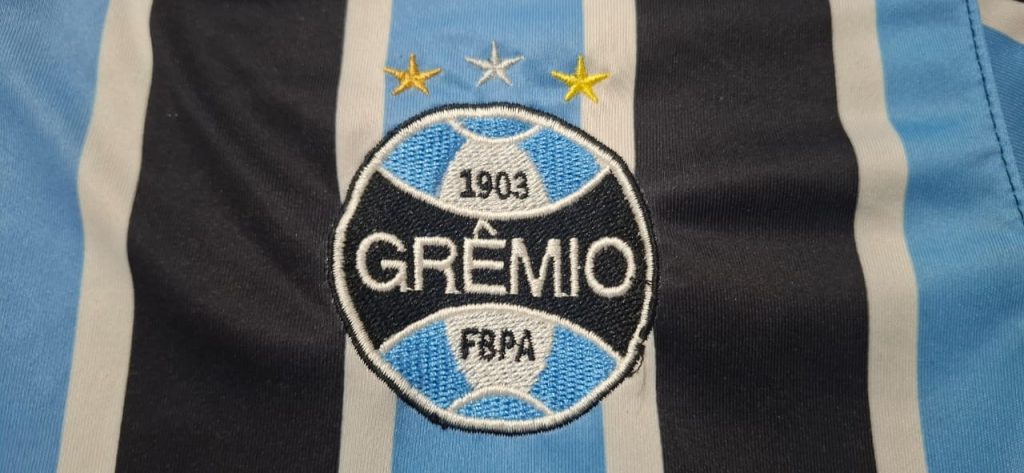
Grêmio’s crest is simple, strong, and instantly recognizable. The circular badge displays the club’s blue, black, and white colors, along with its foundation year, reinforcing the club’s long tradition. The current version of the crest was standardized in 1963, featuring the circular format and the name “Grêmio FBPA.”
Above the badge are three stars, approved in April 1985, representing major achievements in the club’s history: the gold star for the Intercontinental Cup, the silver star for the Copa Libertadores, and the bronze star for the Brazilian Championship.

Grêmio’s Mascots

Grêmio’s Iconic Mascot: The Mosqueteiro
One of the most distinctive symbols of Grêmio’s identity is its mascot, the Mosqueteiro (Musketeer).
The character was created in 1946 by cartoonist Pompeu for the newspaper Folha da Tarde, where it appeared in comic strips representing the club. In those stories, the Mosqueteiro competed for the affection of “Rosinha,” a character who symbolized the Campeonato Gaúcho trophy.
The first drawing of the mascot was reportedly inspired by Francisco Maineri, a Grêmio director known for his strong personality. In the storyline, the Mosqueteiro eventually “married” Rosinha in 1946, symbolizing the club’s victories. The character quickly became popular, and the club even launched a newspaper called O Mosqueteiro that same year to share team news.
Over time, the mascot evolved from a simple newspaper illustration into the familiar stadium figure seen today, usually portrayed with a hat, sword, and the club’s blue, black, and white colors, representing bravery, loyalty, and unity among supporters.
Flecha Negra: A Tribute to a Club Legend
Alongside the Mosqueteiro, Grêmio also introduced Flecha Negra (Black Arrow) as an official mascot to honor Tarcísio Flecha Negra, one of the greatest players in the club’s history.
The legendary forward played for Grêmio between 1973 and 1986, scored 228 goals, and was part of the teams that won the Brazilian Championship and the Intercontinental Cup.
The mascot was officially launched in 2024 as part of club initiatives focused on anti-racism and the recognition of historical figures who shaped Grêmio’s legacy. Supporters were involved in the process through cultural contests organized by the club, helping define the visual traits of the character.
With Flecha Negra, Grêmio celebrates both its history and its commitment to inclusion and respect in Brazilian football culture. Check out the new mascot here.
Most Important Titles
Grêmio is considered one of the major forces in Brazilian football history. Over the decades, the club has built an impressive trophy cabinet at both national and international levels.
• Rio Grande do Sul State Championship (Campeonato Gaúcho) – 1921, 1922, 1926, 1931, 1932, 1946, 1949, 1956, 1957, 1958, 1959, 1960, 1962–1968, 1977, 1979, 1980, 1985–1990, 1993, 1995–1996, 1999, 2001, 2006, 2007, 2010, 2018–2023, 2026
• Brazilian National League (Campeonato Brasileiro Série A) – 1981, 1996
• Brazil Cup (Copa do Brasil) – 1989, 1994, 1997, 2001, 2016
• South American Champions League (Copa Libertadores da América) – 1983, 1995, 2017
• Intercontinental Cup (FIFA Club World Cup predecessor) – 1983
• Recopa Sudamericana – 1996, 2018
• Brazilian Supercup (Supercopa do Brasil) – 1990
• Copa Sul (South Brazil Cup) – 1999
These achievements helped establish Grêmio as a respected name not only in Brazil but across South America.
And if you’re a football lover visiting Brazil, you can’t miss our RioLIVE! Maracanã experience. Come with us and explore the most iconic stadium in Brazil, feel the passion of the fans, and immerse yourself in Brazilian football culture while watching a match or touring the legendary temple of football!
Série B: The Fall, the Fight, and the Comeback
Even football giants face difficult chapters.
Throughout its history, Grêmio has experienced three relegations from Brazil’s top division, Série A. Each one marked a difficult moment for the club and its supporters:
- 1991: The club’s first relegation, finishing in 19th place with only 3 wins in 19 matches.
- 2004: The second fall, when Grêmio ended the season at the bottom of the table (24th place).
- 2021: The third relegation came in dramatic fashion. Even after defeating Atlético-MG 4–3 in the final round, Grêmio finished 17th with 43 points, which confirmed the drop to Série B.
For a club with such a strong history in Brazilian and South American football, these moments were deeply felt by the torcida. Relegation in Brazil is intense, emotional, and highly symbolic.
But the story doesn’t end with the fall.
In 2022, Grêmio competed in Série B, Brazil’s second division. Instead of collapsing under the pressure, the club embraced the challenge. Backed by one of the most passionate fan bases in the country, Grêmio fought through a demanding season and secured its return to Série A.
That campaign became part of the club’s mythology. In Brazilian football culture, suffering and resilience often go hand in hand, and comebacks like this strengthen the bond between a club and its torcida even more.
Tricolor Legends
Throughout its history, Grêmio has been home to players who became national and global stars. Some were developed at the club; others became icons wearing the famous blue, black, and white jersey. But all of them left a mark on the hearts of gremistas.
Ronaldinho Gaúcho

Ronaldinho Gaúcho began his professional career at Grêmio, where his dribbling, creativity, and joy on the ball quickly made him stand out. The nickname actually helps distinguish him from another Brazilian superstar of the same era: Ronaldo Fenômeno. Since both players were named Ronaldo, the younger one became known as Ronaldinho (“little Ronaldo”), and the addition “Gaúcho” refers to someone from the southern Brazilian state of Rio Grande do Sul, where Grêmio is located.
Ronaldinho started his professional journey at Grêmio in the late 1990s, and from the start, it was clear he was special. His dribbling, creativity, and joyful style of play quickly made him a fan favorite in Porto Alegre. Before conquering Europe, winning the Ballon d’Or, and lifting the World Cup with Brazil, he was dazzling crowds in the blue, black, and white jersey.
After his legendary years in Europe, Ronaldinho returned to Brazilian football and also had a spell with Flamengo, one of Rio de Janeiro’s biggest clubs, where he scored 28 goals in 74 matches.
For many gremistas, watching a young Ronaldinho grow into a global icon remains one of the most unforgettable chapters in the club’s history.
Renato Gaúcho
If there’s one name that perfectly represents Grêmio’s identity, it’s Renato Gaúcho. He made history as both a player and a coach for the club. As a player in the 1980s, he was decisive, charismatic, and fearless. He scored crucial goals and helped Grêmio win major titles, becoming one of the greatest idols in the club’s history.
Years later, he returned as a coach and once again led the Tricolor to glory, including a Copa Libertadores title. Few figures in Brazilian football have such a deep and lasting connection with a single club.
Currently, Renato Gaúcho continues his journey in Brazilian football as the head coach of Vasco da Gama, bringing the same charisma, experience, and competitive spirit that made him such an iconic figure during his playing days.
Renato isn’t remembered only for trophies; he also represents confidence, personality, and the bold southern spirit often associated with Grêmio.

Luis Suárez

When Luis Suárez joined Grêmio in 2023, his arrival attracted major attention in Brazilian football. The Uruguayan striker, famous for his goals and competitive intensity, brought international visibility to the club after a successful European career with teams such as Barcelona, Liverpool, and Atlético Madrid.
Suárez made an immediate impact. In his debut match in the Recopa Gaúcha, he scored a hat-trick, helping secure the title. During his time with the club, he also played a decisive role in winning the Campeonato Gaúcho and the Recopa Gaúcha in 2023, quickly becoming a key player and a fan favorite.
For many supporters, Suárez’s presence demonstrated that Grêmio remains capable of attracting world-class talent and maintaining its relevance on the international football stage.
Hugo de León
One of the most respected figures in Grêmio’s history is Hugo de León, the Uruguayan defender known for his leadership and determination. He joined the club in January 1981 from Nacional (Uruguay) and went on to play 242 matches for Grêmio, quickly becoming a central figure in the team’s defense.
De León played a decisive role in some of the most important achievements in the club’s history. He was captain during the historic 1983 season, leading Grêmio to its first Copa Libertadores title and later the Intercontinental Cup the same year. He was also a key player in the squad that won the Brazilian Championship in 1981, helping establish one of the most successful eras in the club’s history.
Known for his “raça e fibra” (grit and determination), De León became the embodiment of the classic Uruguayan defender who never gives up, a profile that strongly resonated with Grêmio’s fighting identity. After his playing career, he also had a brief stint as Grêmio’s head coach in 1997, further strengthening his connection with the club.

Jarde

Jardel remains one of the greatest goal scorers in Grêmio’s history. The powerful striker became one of the club’s biggest idols during the 1990s thanks to his incredible ability to score goals, especially with his precise headers.
Jardel was the top scorer who helped lead Grêmio to one of its greatest achievements: the Copa Libertadores title in 1995, scoring a total of 12 goals. His instinct inside the penalty area and his physical presence made him a nightmare for defenders across South America.
ith countless goals and unforgettable performances, Jardel earned a special place in the hearts of Grêmio fans, becoming one of the most celebrated forwards to ever wear the blue, black, and white jersey.
Danrlei
Every legendary team needs a goalkeeper who can rise to the biggest moments, and for Grêmio in the 1990s, that player was Danrlei. Calm under pressure and known for his crucial saves, he became one of the most respected goalkeepers in the club’s history.
Danrlei was the man between the posts during some of the club’s greatest triumphs, including the historic Copa Libertadores victory in 1995. His performances in decisive matches made him a symbol of reliability and leadership for the team.
After retiring from football, Danrlei followed a different path and entered politics, eventually being elected federal deputy for the state of Rio Grande do Sul, maintaining his connection with the region where he built his legacy.

Dinho

Nicknamed “O Cangaceiro,” Dinho was the heart of Grêmio’s midfield during the 1990s. Known for his toughness, leadership, and relentless determination, he embodied the fighting spirit that the club is famous for.
Dinho played a crucial role in one of the most successful eras in Grêmio’s history. His strength in midfield helped the team conquer major titles, including the Copa Libertadores and the Brazilian Championship, solidifying his reputation as a true leader on the pitch.
With his fearless style, intense defense, and unwavering commitment, Dinho became one of the most admired figures in the team’s history, symbolizing the passion and resilience that define Grêmio.
Paulo Nunes
In the powerful Grêmio team of the 1990s, Paulo Nunes was one of the key attacking players who helped shape the club’s success. Known for his speed, skill, and intelligent movement on the field, he quickly became a fan favorite in Porto Alegre.
Paulo Nunes formed a famous attacking partnership with Jardel, creating one of the most dangerous duos in Brazilian football at the time. Together, they played an important role in Grêmio’s victories during that golden decade, combining creativity with decisive goals.
With memorable performances and crucial strikes in important matches, Paulo Nunes secured his place among the Grêmio legends, leaving a lasting mark on the club’s history and on the hearts of its supporters.

Roger Machado

Among the great defenders in Grêmio’s history, Roger Machado stands out as one of the club’s most reliable and talented left-backs. Playing for the Tricolor during the 1990s, he became an essential part of a generation that brought tremendous success to the club.
Roger combined strong defensive skills with intelligence and consistency on the field. He played an important role in several of Grêmio’s biggest achievements of the decade, including the historic Copa Libertadores title in 1995.
Thanks to his commitment and solid performances in the blue, black, and white jersey, Roger Machado secured his place among the club’s most respected players and is proudly remembered as one of the great gremista idols.
The Gre-Nal Rivalry: Grêmio vs Internacional

One of the most intense rivalries in world football takes place in Porto Alegre: Grêmio vs Internacional, a derby known as Gre-Nal.
The name combines Grêmio (Gre) and Internacional (Nal), and the rivalry divides the entire state of Rio Grande do Sul. More than a football match, Gre-Nal is a cultural event filled with passion, pride, and tension, where families, friends, and even workplaces often split between the blue, black, and white of Grêmio and the red of Internacional.
Played since 1909, the derby has produced hundreds of memorable clashes. By March 2026, 451 matches had been played in the history of Gre-Nal, with Internacional winning 166 games, Grêmio winning 143, and 142 matches ending in draws. In terms of goals, Internacional scored 616, while Grêmio scored 567. The most recent meeting before this count was Gre-Nal 451, played on March 8, 2026, for the Campeonato Gaúcho, which ended in a draw.
Where Grêmio Makes Magic Happen

Grêmio plays its home matches at the Arena do Grêmio, a modern stadium inaugurated in 2012 in Porto Alegre. The move to the Arena was completed in 2013, replacing the historic Estádio Olímpico Monumental, where many of the club’s most important titles were celebrated.
The stadium has already hosted major moments. Its record attendance came during the inaugural match against Hamburg in 2012, with 60,100 fans in the stands. In 2026, the Arena again welcomed more than 50,000 supporters during the Campeonato Gaúcho final, showing the strength of the torcida.
The Arena is also known for its modern structure. In December 2025, it became the first Série A stadium to install Tahoma Bermuda grass, the same turf chosen for the 2026 FIFA World Cup in the United States. The complex is designed as a multi-use venue for sports and large events and also offers the Arena Tour, a guided visit that includes access to the locker rooms, pitchside, and the Hermínio Bittencourt Museum, which displays the club’s trophies and history.
Grêmio’s Anthem
All great teams have a song that connects all their fans, and Grêmio is no different. The club’s anthem is a declaration of pride, passion, and loyalty. It’s sung by fans before and during matches, helping turn the Arena do Grêmio into one of the most intense atmospheres in Brazilian football. Below, you’ll find the original song and lyrics in Portuguese and the translation:
Até a pé nós iremos
para o que der e vier
mas o certo é que nós estaremos
com o Grêmio onde o Grêmio estiver
Cinqüenta anos de glórias
tens imortal tricolor
os feitos da tua história
canta o Rio Grande com amor
Nós como bons torcedores
sem hesitarmos sequer
aplaudiremos o Grêmio
aonde o Grêmio estiver
Lara o craque imortal
soube seu nome elevar
hoje com o mesmo ideal
nós saberemos te honrar
We’ll even walk there
whatever happens
but one thing is certain: we’ll be
with Grêmio wherever Grêmio may be
Fifty years of glory
you are immortal, tricolor
the achievements of your history
Rio Grande sings with love
We, as good fans,
without hesitation,
will applaud Grêmio,
wherever Grêmio may be.
Lara, the immortal star,
knew how to elevate your name.
Today, with the same ideal,
we will know how to honor you.
Can you feel the chills? Incredible, right? Now imagine more than 55,000 fans singing it together in unison, wearing the Grêmio colors inside the Arena do Grêmio. This spine-tingling, unforgettable experience is one that every football lover should witness when visiting Porto Alegre.
Would You Cheer for Grêmio?

With its powerful history, legendary players, resilient comeback story, iconic mascot, and unmistakable jersey, it’s easy to understand why Grêmio holds such a special place in Brazilian football culture.
Had you heard of Grêmio before? Would you cheer for the Tricolor from Porto Alegre?
Stay tuned for more Dicas about Brazilian culture and football!
Big hugs from Rio de Janeiro, gurizada!
Click on the links below to see more related Dicas
Flamengo Football Club
Fluminense Football Club
Santos FC
Botafogo Soccer Club

Antônio Kath is our “Cariucho” — a Gaúcho teacher based in Rio de Janeiro who brings warmth, humor, and real teaching craft to Portuguese classes. He holds a degree in Portuguese/English from UERJ and has 6 years of experience teaching Brazilian Portuguese in-person and online in both private and public institutions. His classes focus on real-life communication, clear explanations, and practical feedback—so students can speak naturally and confidently. With a background in martial arts, literature, and online culture (especially slang), he is always looking for ways to bring joy to the classroom and make any learning experience a memorable one. When he’s not teaching, you’ll find him practicing Brazilian Jiu-Jitsu, training Muay Thai, cheering for Vasco, or playing games with his friends.
PakarPBN
A Private Blog Network (PBN) is a collection of websites that are controlled by a single individual or organization and used primarily to build backlinks to a “money site” in order to influence its ranking in search engines such as Google. The core idea behind a PBN is based on the importance of backlinks in Google’s ranking algorithm. Since Google views backlinks as signals of authority and trust, some website owners attempt to artificially create these signals through a controlled network of sites.
In a typical PBN setup, the owner acquires expired or aged domains that already have existing authority, backlinks, and history. These domains are rebuilt with new content and hosted separately, often using different IP addresses, hosting providers, themes, and ownership details to make them appear unrelated. Within the content published on these sites, links are strategically placed that point to the main website the owner wants to rank higher. By doing this, the owner attempts to pass link equity (also known as “link juice”) from the PBN sites to the target website.
The purpose of a PBN is to give the impression that the target website is naturally earning links from multiple independent sources. If done effectively, this can temporarily improve keyword rankings, increase organic visibility, and drive more traffic from search results.