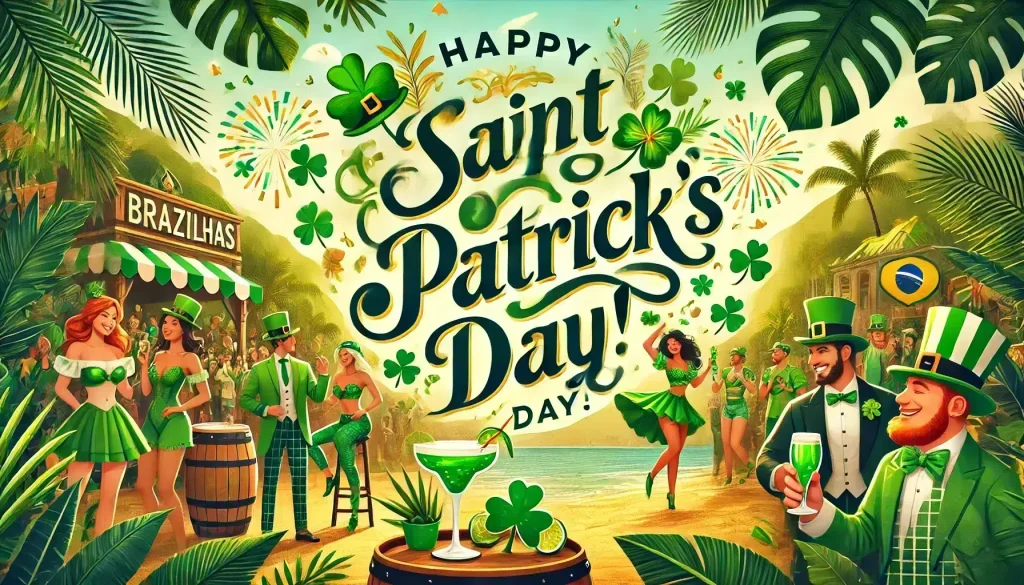

Brazil is a land of diversity, where cultures from around the world have blended into something uniquely beautiful. But did you know that even the Irish have left their mark on this tropical paradise? That’s right! The story of Irish Brazilians is one of adventure, resilience, and unexpected connections between the Emerald Isle and the Land of Samba. Let’s celebrate Saint Patrick’s Day with A Dica do Dia!
The Irish in Brazil: How Did They Get Here?
When we think of Irish immigration, the United States often comes to mind, but Brazil also received its fair share of Irish settlers. The first recorded Irish settlers arrived in the late 16th century, brought by the Iberian Union, when Portugal and Spain were under the same crown. Some of these early Irishmen were traders, mercenaries, and sailors who settled in Brazilian coastal cities.
Later, in the early 19th century, a larger wave of Irish immigrants arrived, drawn by the promise of new opportunities. Some came as part of military units, such as the Irish Battalion of the Emperor, recruited to help Brazil in its wars of independence. Others arrived seeking a fresh start, often settling in Rio de Janeiro, São Paulo, and the Northeast.
One of the most interesting Irish immigration attempts was the establishment of Colônia Irlanda in Bahia, a settlement planned for Irish families. However, things didn’t go as expected—many of the settlers struggled with the tropical climate and economic difficulties, leading to the colony’s decline. But despite these hardships, many Irish immigrants stayed and blended into Brazilian society.
From Guinness to Cachaça: The Irish-Brazilian Connection
So, what remains of the Irish influence in Brazil today? While Brazil may not have Irish castles or leprechauns, the Irish did contribute to its history and culture in several ways:
🍀 Names and Surnames – Ever met a Brazilian with the last name Carroll, O’Neill, or Murphy? They likely have Irish roots! Many Irish immigrants adapted their surnames to fit Portuguese conventions, often dropping the common “O’” prefix.
🍀 St. Patrick’s Day in Brazil – While not a traditional Brazilian celebration, cities like São Paulo and Rio de Janeiro have embraced the Irish spirit with vibrant St. Patrick’s Day festivals. Expect green beer, Irish music, and plenty of dancing—almost like a bloco de Carnaval!
🍀 Feliz Dia de São Patrício! – In Portuguese, St. Patrick’s Day is Dia de São Patrício. Interestingly, while Patrício is rarely used as a masculine name in Brazil, the feminine version, Patrícia, is quite popular!
🍀 Religious Influence – Many Irish immigrants were Catholic and contributed to the expansion of churches and schools in Brazil. Historical records even mention Irish priests serving in Brazilian parishes.
Irish Descendants in Brazil: Are There Irish Brazilians Today?
Although the original waves of Irish immigration to Brazil were relatively small, their legacy did not disappear. Over generations, many families blended into Brazilian society, adopting Portuguese as their primary language while keeping traces of Irish ancestry through surnames, oral history, and family traditions.
Today, identifying the exact number of Irish descendants in Brazil is difficult, since most are fully integrated into Brazilian culture. However, genealogical interest has grown in recent years, especially among Brazilians researching family roots and discovering unexpected Irish connections.
In this way, the term “Irish Brazilians” does not only refer to immigrants from Ireland, but also to generations of Brazilians whose heritage links back, sometimes subtly, to the Emerald Isle.
Irish Culture in Brazil Today
While the Irish presence in Brazil was never as large as in North America, traces of Irish culture can still be found today, especially in major cities like Rio de Janeiro and São Paulo. From pub gatherings to cultural meetups, the story of the Irish Brazilians continues in subtle but meaningful ways.
In big urban centers, Irish-themed pubs serve as informal hubs for locals, expats, and travelers. Around special dates, especially in March, these spaces host live music, themed events, and celebrations that bring together both Brazilians and visitors curious about Irish traditions.
There are also institutional and cultural links that help maintain the connection. Events supported by the Irish Embassy, academic exchanges, and Ireland–Brazil business networks contribute to keeping Irish culture visible in Brazil beyond the holiday atmosphere. Though modest in scale, the Irish cultural footprint in Brazil remains present and evolving.
Saint Patrick’s Day in Brazil: What to Expect
Saint Patrick’s Day may not be a traditional Brazilian holiday, but it has grown in popularity over the past decade. If you’re wondering what Saint Patrick’s Day in Brazil looks like, expect a festive mix of Irish symbolism and Brazilian energy.
In cities like São Paulo and Rio de Janeiro, pubs and bars decorate in green, serve Irish-inspired drinks, and organize live music nights. Some venues feature Irish folk bands or themed DJ sets, while others embrace a party atmosphere that feels almost like a mini-Carnaval with more shamrocks.
Although it’s not a public holiday, the celebration has become part of the urban cultural calendar. For many Brazilians, it’s less about heritage and more about enjoying global traditions in a uniquely Brazilian way, proving once again how easily Brazil blends outside influences into its own vibrant culture.
Brazil Meets Ireland: A Friendship That Lasts
Today, Brazil and Ireland share more than just historical ties. Many Brazilians have moved to Dublin and other Irish cities in search of new opportunities, while Irish visitors fall in love with Brazil’s warmth, music, and beaches. This cultural exchange continues, proving that no matter how far apart two countries are, strong connections can last forever.
So, next time you sip a caipirinha or hear the rhythm of samba, remember that many cultures—including the Irish—have helped shape Brazil into the rich, diverse country it is today. And if you ever find yourself in an Irish pub in Brazil, raise a toast to this fascinating connection: Sláinte e saúde! 🇮🇪🇧🇷
Happy Saint Patrick’s Day!
Click on the links below to see more related Dicas
Nationalities in Portuguese
Country in Portuguese
Brazil-USA Relations

CEO and Founder of Rio & Learn Portuguese School.
A visionary leader and innovative marketer, Albert has over two decades of experience in brand management, marketing strategy, educational leadership and everything around Brazil. As the CEO of Rio&Learn, he transformed Portuguese language education, creating immersive and culturally rich learning experiences for foreign students.
PakarPBN
A Private Blog Network (PBN) is a collection of websites that are controlled by a single individual or organization and used primarily to build backlinks to a “money site” in order to influence its ranking in search engines such as Google. The core idea behind a PBN is based on the importance of backlinks in Google’s ranking algorithm. Since Google views backlinks as signals of authority and trust, some website owners attempt to artificially create these signals through a controlled network of sites.
In a typical PBN setup, the owner acquires expired or aged domains that already have existing authority, backlinks, and history. These domains are rebuilt with new content and hosted separately, often using different IP addresses, hosting providers, themes, and ownership details to make them appear unrelated. Within the content published on these sites, links are strategically placed that point to the main website the owner wants to rank higher. By doing this, the owner attempts to pass link equity (also known as “link juice”) from the PBN sites to the target website.
The purpose of a PBN is to give the impression that the target website is naturally earning links from multiple independent sources. If done effectively, this can temporarily improve keyword rankings, increase organic visibility, and drive more traffic from search results.