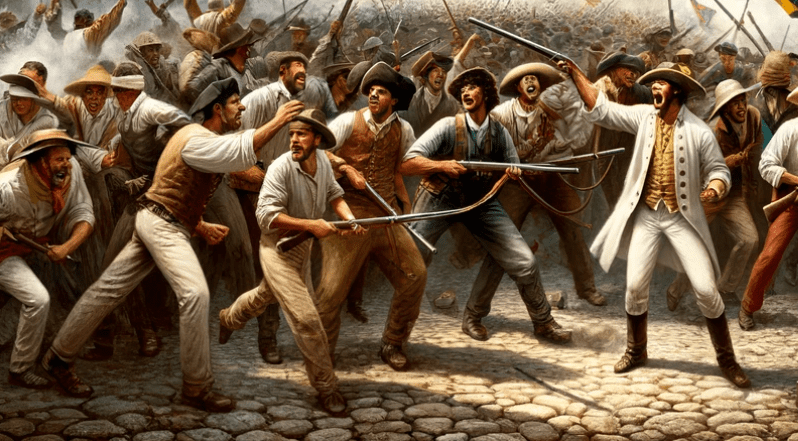

Have you ever wondered about the lesser-known revolutions that shaped Brazil’s journey to independence? While Brazilian Independence Day on September 7, 1822, is widely celebrated, many pivotal moments in history remain overlooked. One such event is the 1817 Pernambuco Revolution, a key movement in Brazil’s pursuit of independence that left a lasting impact.
Today, in our Dica do Dia, we’ll explore this historic date, commemorated on March 6.
Understanding the 1817 Pernambuco Revolution
Join us as we delve into the causes, key figures, significant events, and the aftermath of this remarkable revolution. Discover why this often-overlooked movement was so crucial in Brazil’s history and how it influenced future revolutionary efforts.
Prefer listening over reading? Scroll down to find a podcast episode at the end of our Dica for an alternative way to explore this fascinating topic!
Pernambuco in the Early 19th Century
Welcome to early 19th-century Pernambuco, a bustling region in northeastern Brazil. With its fertile lands, lush forests, and strategic coastal location, Pernambuco thrived on trade with Europe, Africa, and other Brazilian provinces. However, the region faced growing discontent due to political and economic inequalities.
Inspired by the ideals of the French Revolution, Pernambuco’s intellectuals and progressive thinkers championed liberty, equality, and self-governance. Enlightenment principles fueled the ambitions of local elites, who sought to establish a representative government that would secure political rights and economic justice for the people.
Yet, under Portuguese rule, Pernambuco suffered from heavy taxation and economic decline. Once a dominant sugar-producing region, it was losing ground to more productive plantations elsewhere. Political corruption and authoritarian rule further deepened local frustrations, setting the stage for rebellion.
Causes of the 1817 Pernambuco Revolution
A combination of economic hardship, political repression, and revolutionary ideals ignited the 1817 Pernambuco Revolution. The movement was driven by a strong desire for autonomy and fueled by dissatisfaction with Portuguese control. This rebellion became a defining moment in Brazil’s path to independence.
| Causes of the 1817 Pernambuco Revolution |
|---|
| Decrease in the economic importance of the region |
| Portuguese Crown was favoriting southern regions |
| Political corruption and authoritarian Portuguese rule |
| Influence of Enlightenment ideals |
| External influences like the French Revolution |
Key Figures and Events of the Revolution
The revolution was led by influential figures who played crucial roles in organizing and inspiring the movement:
Frei Caneca
A Franciscan friar and political leader, Frei Caneca was a key revolutionary figure. He used his intellectual influence to rally support and advocate for social and economic reforms.
Domingos José Martins
A lawyer and journalist, Domingos José Martins spread revolutionary ideas through his writings. His work galvanized public support and encouraged the fight against oppression.
Henrique Dias
A skilled military commander, Henrique Dias led rebel forces in battle against Portuguese troops. His strategic leadership was instrumental in resisting colonial rule.
Significant Events
- March 6, 1817 – The revolutionaries declared Pernambuco’s independence from Portugal, sparking the rebellion.
- Formation of a Provisional Government – Leaders established a temporary government to govern the newly declared independent state.
- Battles Against Portuguese Forces – Fierce clashes took place across the region, including key confrontations in Recife and other towns.
- The Siege of Recife – A decisive battle where revolutionaries defended the capital against Portuguese forces.
Despite their determination, the revolutionaries faced overwhelming opposition from the Portuguese Crown.
Suppression and Aftermath of the Revolution
Following the fervor and momentum of the 1817 Pernambuco Revolution, the forces of the government swiftly moved to suppress the uprising. With a combination of military might and political maneuvering, the rebellion was ruthlessly quelled, leaving a lasting impact on the region and Brazil as a whole.
The suppression of the revolution led to a period of turmoil and retribution. Governmental forces enacted severe punishments for those involved in the uprising, seeking to deter future revolutionary movements. Many revolutionaries were captured, imprisoned, and executed, with some facing exile or harsh labor. The suppression wanted to send a chilling message throughout the region, wanting to discourage dissent and solidifying the authority of the ruling elite.
The aftermath of the revolution witnessed a significant shift in the political landscape. The government, in response to the uprising, implemented measures aimed at centralizing power and reestablishing control. The region of Pernambuco, once a hotbed of revolutionary fervor, became a subdued and oppressed territory.
The Impact of the Revolt of 1817
The End of Portuguese Rule in Brazil
Although the revolution was ultimately defeated, it helped lay the foundation for Brazil’s independence in 1822. The ideas of liberty, equality, and democracy that fueled the uprising continued to spread, inspiring future movements.
The Rise of Brazilian Nationalism
The 1817 Pernambuco Revolution also played a crucial role in the rise of Brazilian nationalism. It united people from different backgrounds in their common pursuit of independence and a better future, strengthening the country’s emerging national identity.
The Legacy of the Revolt of 1817
Today, the 1817 Pernambuco Revolution is remembered as a defining moment in Brazilian history, especially in the Northeast. It symbolizes resistance against oppression and the ongoing struggle for social justice and equality. The flag of Pernambuco, adopted in 1917 to commemorate the centennial of the revolt, bears the date 1817 as a tribute to those who fought for freedom.

One of the notable legacies of the 1817 Pernambuco Revolution is the ideological influence it exerted on future generations. The revolution introduced revolutionary ideals of democracy, freedom, and equality to Brazilian society, leaving an indelible mark on the collective consciousness of the nation. These ideas resonated with subsequent revolutionary movements, fostering a sense of national unity and the desire for self-determination.
The revolution’s impact extended beyond the confines of Pernambuco, influencing the broader movement for Brazilian independence. The spirit of resistance and the demand for political change that characterized the revolution echoed throughout the country, inspiring future uprisings and revolutionaries. The 1817 Pernambuco Revolution played a pivotal role in laying the foundation for the eventual attainment of Brazil’s independence, making it an integral part of the nation’s history.
The enduring legacy of the 1817 Pernambuco Revolution is a testament to the resilience and determination of the Brazilian people. It serves as a reminder of the power of unity and the pursuit of freedom, inspiring generations to advocate for justice and equality. As Brazil continues to navigate its path toward progress, the legacy of the 1817 Pernambuco Revolution remains a beacon of hope and a testament to the enduring spirit of its people.
With Rio & Learn RioONLINE! Activities you will be able to learn about history and a lot of Brazilian-related subjects while you have fun with a Portuguese teacher!
Pernambucan Revolution Day
To honor this historic event, the state of Pernambuco celebrates March 6 as an official holiday, paying tribute to the revolutionaries who fought for independence.
Podcast Episode on 1817 Pernambuco
Want to learn more? Listen to our Podcast Episode! Available in English and Portuguese—simply switch the language at the top of our menu.
Final Thoughts on the Pernambucan Revolution
The 1817 Pernambuco Revolution was a powerful statement against colonial rule and a key milestone in Brazil’s fight for independence. The ideals of liberty, equality, and democracy that emerged from the movement continue to shape Brazilian society today.
Did you know that Pernambuco was once a Dutch colony in the 17th century? Check out our Dica to learn more about Dutch Pernambuco!
See you in our next Dica do Dia!
Click on the links below to see more related Dicas
Brazil States
Tiradentes
Bahia Independence Day
Rio de Janeiro History
Dia do Fico

CEO and Founder of Rio & Learn Portuguese School.
A visionary leader and innovative marketer, Albert has over two decades of experience in brand management, marketing strategy, educational leadership and everything around Brazil. As the CEO of Rio&Learn, he transformed Portuguese language education, creating immersive and culturally rich learning experiences for foreign students.
PakarPBN
A Private Blog Network (PBN) is a collection of websites that are controlled by a single individual or organization and used primarily to build backlinks to a “money site” in order to influence its ranking in search engines such as Google. The core idea behind a PBN is based on the importance of backlinks in Google’s ranking algorithm. Since Google views backlinks as signals of authority and trust, some website owners attempt to artificially create these signals through a controlled network of sites.
In a typical PBN setup, the owner acquires expired or aged domains that already have existing authority, backlinks, and history. These domains are rebuilt with new content and hosted separately, often using different IP addresses, hosting providers, themes, and ownership details to make them appear unrelated. Within the content published on these sites, links are strategically placed that point to the main website the owner wants to rank higher. By doing this, the owner attempts to pass link equity (also known as “link juice”) from the PBN sites to the target website.
The purpose of a PBN is to give the impression that the target website is naturally earning links from multiple independent sources. If done effectively, this can temporarily improve keyword rankings, increase organic visibility, and drive more traffic from search results.
