
Who knew a bus ticket could offer such an adventure? In Rio de Janeiro, hopping on a city bus is less about transportation and more about a wild, unforgettable ride! Forget theme park roller coasters—this is the real deal. Buckle up (if there were seat belts!) and let us guide you through the thrilling, unpredictable world of Rio’s buses.
The Art of Catching a Bus
Catching a bus in Rio requires courage and a dash of creativity. Simply standing at the stop won’t do. You might need to step slightly into the bus lane to grab the driver’s attention (just a little risk, we promise!). Subtle hand waves? Not enough. Instead, channel your inner performer and wave your arm boldly up and down. Miss this bus, and you might be waiting another 20–30 minutes, so it’s time to fight for your ride!
The Ride of Your Life
Once you’re on the bus, hold on tight! Even if you’ve managed to snag a seat, you’ll need to grab something—anything—to avoid being thrown around when the driver takes a sharp turn or slams on the brakes. Standing? That’s an entirely different level of acrobatics. Seasoned commuters balance like pro surfers, mastering the art of staying upright during sudden stops and accelerations that could rival Formula 1.

Mastering “Motorista!”
Missed your stop? Don’t panic—just scream “Motorista!” loudly to make sure the driver doesn’t zoom past your destination. It’s not just a request; it’s a cultural ritual. Forget being polite or soft-spoken—this is your moment to shine as the loudest passenger on the bus.
The Back Door Secret
While most passengers enter through the front door these days, the back door still holds its charm. Kids, retirees, sellers, and “freeloaders” keep the tradition alive by hopping on (or off) the back. It’s like a secret passage to a bygone era of Rio’s bus culture. Who doesn’t love a little nostalgia?
The “Friendly” Driver
Greeting your driver with a cheerful “Bom dia” or “Boa tarde” is the safest thing to do, but don’t expect a response. Drivers are often laser-focused on their mission: speeding through Rio like their lives depend on it. Oh, and don’t be surprised if your driver decides to keep your change—consider it a “tip” for surviving the ride! And yes, if you ask for stop advice, they may surprise you by remembering your destination even after 30 minutes. How do they do it? It’s part of their charm!
Cash Only, Please (or find your Lost Ark RioCard)
Thinking of using a bus card? Good luck! These mythical objects are hard to come by, as they’re not sold at bus stops or on the buses themselves. Until you find one, make sure to carry cash. If you’re lucky enough to get a card, don’t lose it—recharging it can feel like a quest worthy of a video game.
All jokes aside, there is an easier option that just came fresh out of the oven. In August 2025, the Jaé card was implemented, and you can either have a physical card or use the app on your phone, available for Android or IOS. Not sure where to start? Ask your teacher during one of our RioLIVE! Activities or Rio & Immersion courses.

New Year, New Prices: Bus Ticket in Rio de Janeiro
Starting in January 2026, bus fares in Rio have increased to R$5.00, up from R$4.70. While it’s only 30 cents more, daily commuters are feeling the pinch. Officials promise the increase will improve bus services (fingers crossed!). Make sure to always carry two R$5.00 bills with you, one for going to your destination and one for returning, as drivers rarely have change for larger bills.
New Price: 5,00 Reais
Did you know Brazil once saw major protests over a 20-cent fare hike? The “20 cents movement” even played a role in President Dilma Rousseff’s impeachment. Ask your teacher about this fascinating piece of Brazilian history!
The Legendary Nicknames (or Welcome to the Bus Hall of Fame)
Think buses in Rio are just numbers and routes? Think again. Around here, they earn nicknames, and not the subtle kind. Take the 422, famously called 4 Doidão (Four Crazies), or the 348, known as três-quarto-louco (three-four-crazy), the kind of names that already suggest you’re in for something unpredictable.
Then comes the dramatic 639, nicknamed meia-três-morte (six-three-death), and the 918, known as 9 desgosto (nine dislike – a pun with the number dezoito), which doesn’t exactly inspire confidence. And just when you think it can’t get better, there’s the 410: quatrocentos e dead (four hundred and dead), mixing Portuguese with a touch of English for extra flair.
And of course, there’s the legendary 474, known as quatro sete craque or even linha do inferno, a line so emblematic that it even inspired the book 474 Jacaré/Copacabana, by Gabriel Weber, where he reveals the multiple layers of this bus line so iconic (and chaotic).
This creativity isn’t new either, back in the day, double-decker buses that used to circulate through the city were called chopes duplo, a playful reference to the beloved Brazilian draft beer.
These names aren’t official they come from real experiences, sharp turns, sudden brakes, and a lot of carioca humor. So if you hear someone laughing about a bus before even getting on it, now you know why.
Meet the “Piloto”
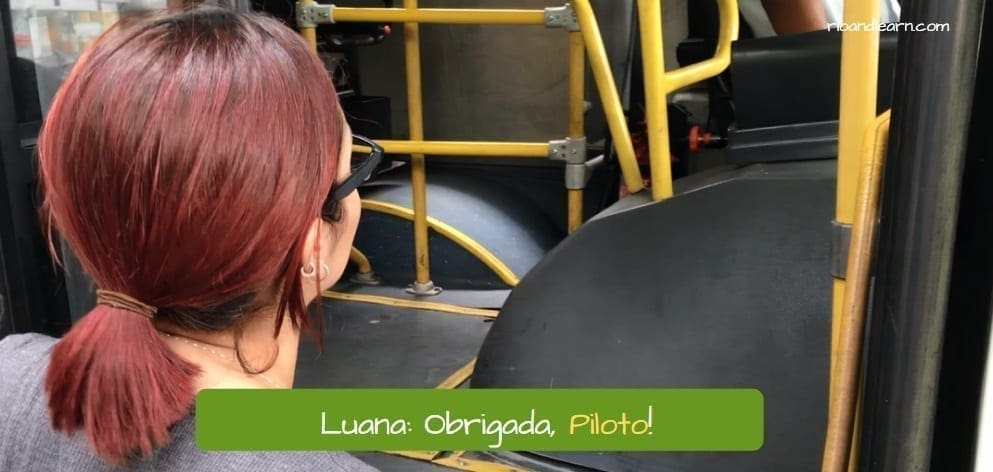
In Rio, bus drivers are affectionately called “Pilotos” (pilots)—and for good reason! Their daring turns, quick accelerations, and fearless overtaking make each ride feel like a race. While it might seem chaotic, rest assured: you’re in skilled hands (most of the time).

Navigating Like a Pro
Google Maps may work wonders elsewhere, but in Rio, Moovit is your best friend for navigating bus routes. Yes, it’s loaded with ads (unless you upgrade), but it’s the most reliable way to find your way through the city’s complex transit system. Download the app here or here for fancy Apple users.
Your Turn! Practice Time:
Let’s practice the basics to help you catch your first bus.
- Write a simple sentence using:
“Dá sinal!” (Signal for the Bus to stop!) - Ask a basic question:
“Esse ônibus vai para…?” (Where does this bus go to…?) - Practice calling the driver:
“Piloto!” - Try to complete this sentence:
“Piloto! Vou descer em ______.”
After you practice, combine your answers into a short, simple dialogue.
Share your sentences with us in the comments or during your next Rio & Learn class, we can’t wait to see your first bus ride adventure!
A bus ride in Rio is never boring. From live music performances to impromptu debates among passengers, every trip is an adventure. And let’s not forget the bus drivers’ creative maneuvers, like overtaking cars on narrow streets or squeezing through impossible gaps in traffic. Who needs amusement parks when you have Rio’s buses?

So, are you ready to hop on and experience the madness? Rio’s buses aren’t just transportation—they’re a cultural immersion and an adrenaline-pumping adventure rolled into one. Grab the exact cash for your bus ticket in Rio de Janeiro, practice your “Motorista!” yell, and embrace the chaos. Happy commuting! 🙂
Click on the links below to see more related Dicas
Subway in Rio de Janeiro
Rio de Janeiro Light Rail
Santa Teresa Tram
Orange Bikes in Rio
Means of Transport in Portuguese

CEO and Founder of Rio & Learn Portuguese School.
A visionary leader and innovative marketer, Albert has over two decades of experience in brand management, marketing strategy, educational leadership and everything around Brazil. As the CEO of Rio&Learn, he transformed Portuguese language education, creating immersive and culturally rich learning experiences for foreign students.
PakarPBN
A Private Blog Network (PBN) is a collection of websites that are controlled by a single individual or organization and used primarily to build backlinks to a “money site” in order to influence its ranking in search engines such as Google. The core idea behind a PBN is based on the importance of backlinks in Google’s ranking algorithm. Since Google views backlinks as signals of authority and trust, some website owners attempt to artificially create these signals through a controlled network of sites.
In a typical PBN setup, the owner acquires expired or aged domains that already have existing authority, backlinks, and history. These domains are rebuilt with new content and hosted separately, often using different IP addresses, hosting providers, themes, and ownership details to make them appear unrelated. Within the content published on these sites, links are strategically placed that point to the main website the owner wants to rank higher. By doing this, the owner attempts to pass link equity (also known as “link juice”) from the PBN sites to the target website.
The purpose of a PBN is to give the impression that the target website is naturally earning links from multiple independent sources. If done effectively, this can temporarily improve keyword rankings, increase organic visibility, and drive more traffic from search results.