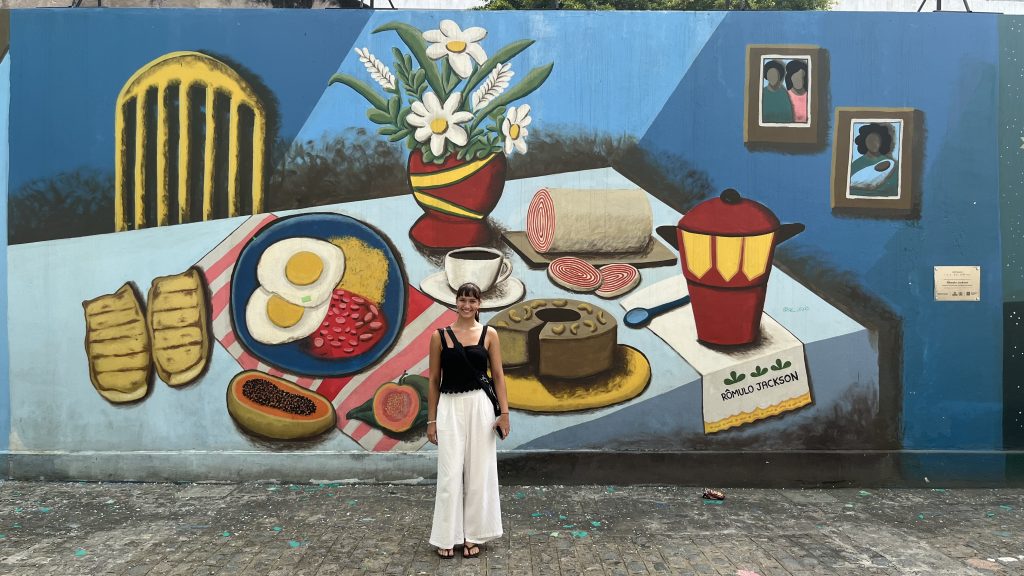

Have you ever thought about understanding a city through its food? Recife is so passionate about its local cuisine that it even showcases this love in the city’s murals.
Of course, you can admire the bridges, the rivers, the beaches, the frevo and maracatu music, Rua do Bom Jesus, and the vibrant energy of Pernambuco. But when you sit down to savor a plate of arrumadinho, try a piece of bolo de rolo, or eat tapioca near the beach, Recife becomes much more than a coastal city. More intimate. More alive. More Brazilian.
It is like people from Recife say: Recife is the best city in the world!
The food in Recife, Brazil, is full of history, flavor, and personality. It brings together Portuguese, African, and Indigenous influences, but also carries something very local: the coastal soul of Recife, the creativity of Pernambuco, and the relaxed rhythm of people who know that good food deserves time.
So, if you’re curious about Recife’s food, come hungry. This city has seafood, street food, regional dishes, beach food, traditional sweets, and many delicious reasons to practice your Portuguese in real life, one menu, one waiter, and one unforgettable dish at a time.
Seafood in Recife: The Taste of the Coast
In Recife, the sea isn’t just scenery. It appears on the plate in fish stews, shrimp dishes, crab snacks, beach lunches, and regional recipes brimming with coastal flavor.
Seafood is common in traditional restaurants, beach kiosks, informal bars, and regional food stalls. Shrimp, crab, fish, mussels, and other seafood are usually accompanied by rice, farofa (toasted cassava flour), vegetables, coconut milk, bell peppers, tomatoes, onions, garlic, and fresh herbs.
One dish worth trying is caldinho. Generally, you can understand it as a small soup with a thick broth. But the Pernambuco secret is in the preparation. Here, caldinho is highly seasoned during cooking, blended until smooth, and served in a beer glass or small bowl. In restaurants or at beachside stalls, vendors may add quail eggs, shrimp, corn, olives, chili sauce, and pork rinds, although pork rinds are usually not included in seafood broths. So, are you hungry yet? Then check out this list of typical broths from Recife and the surrounding area:
- Shrimp Broth: One of the most popular seafood broths in Pernambuco. Commonly found at Boa Viagem Beach and in Recife’s bars. Creamy, rich, and packed with shrimp flavor.
- Sururu Mussel Broth: Strongly connected to the coastal cuisine of Northeastern Brazil. Made with sururu mussels and traditional seasonings. Known for its distinctive seafood taste.
- Fish Broth: Prepared with fresh local fish and aromatic herbs. Light yet flavorful. A favorite among seafood lovers along the coast.
- Crab Broth: Made with crab meat and a blend of regional spices. Rich, savory, and slightly sweet. Often enjoyed as a starter or beachside snack.
- Seafood Broth: A combination of shrimp, fish, mussels, and other seafood. Rich and hearty with layers of maritime flavors. A popular choice in seafood restaurants.
In the image below, you can see siri, a type of crab common in Recife’s cuisine. It is often caught by local fishermen, and in a city surrounded by rivers, mangroves, and the sea, local seafood commerce is still very strong.

Sitting on the beach, ordering a hearty broth with an ice-cold beer or coconut water is all you need to relax. And have you ever thought about learning Portuguese while enjoying this? Rio & Learn offers you this in an immersion program in Recife.
Regional Food in Recife: Strong, Comforting, and Full of Identity
Recife is a great place to explore comida regional, or regional food from Pernambuco and the Northeast of Brazil.
This is where the food becomes heartier. You will find ingredients like carne de sol, macaxeira, queijo coalho, black-eyed peas, farofa, beans, rice, and tropical fruit. These are not just ingredients on a menu. They are part of the everyday food culture of the region.
A great example is Arrumadinho. This dish usually combines chopped sun-dried beef, black-eyed peas, diced vegetables, and farofa, creating a colorful and filling plate. It is simple, generous, and very Brazilian.
Another traditional dish is Galinha à Cabidela, a chicken stew made with chicken blood and vinegar, which gives the sauce a rich brown color and a very distinctive flavor. It may sound unusual to some visitors, but it is part of the traditional food culture of Pernambuco and other parts of Brazil.
In the image below, you can see an example of how local ingredients can appear in a modern regional meal: cilantro purée, pumpkin farofa, cherry tomatoes, and a good protein, of course. Cilantro and pumpkin are very present in local cuisine, although pumpkin is often called squash in other parts of Brazil.

This is one of the joys of eating in Recife: you do not only discover new dishes. You discover new ways of understanding food, family, memory, and local identity.
Beach Food in Boa Viagem
In Boa Viagem, Recife’s most famous beachside neighborhood, food becomes part of the beach experience.
You can eat meat, chicken, or queijo coalho skewers, drink chilled coconut water, stop at laid-back bars, visit bakeries and cafés, or sit down for seafood and regional dishes after a walk along the seafront. You may also find peeled pineapple and other fresh fruit sold near the beach. Boa Viagem offers visitors many easy ways to experience Recife’s cuisine without complicating the experience.
Try tapioca for breakfast. Drink coconut water near the beach. Look for dishes with shrimp, cassava, queijo coalho, and tropical fruits. You can also find Pernambuco favorites like arrumadinho, crab croquettes, baião de dois, cartola, and bolo de rolo.
This is where food in Recife feels especially relaxed. Sometimes, the best meal is the one you find between the beach, a bakery, and a conversation with a local.
Tapioca: Simple, Local, and Delicious
Tapioca is made from cassava starch and looks a little like a white crepe or flatbread. It can be filled with sweet or savory ingredients, such as cheese, coconut, banana, chicken, meat, condensed milk, or guava paste.
It is light, quick, and very flexible. You can eat tapioca for breakfast, as a snack, or even as a casual dinner. In Recife and nearby Olinda, tapioca is more than just food. It is part of the local culture and a delicious example of how cassava has shaped Brazilian cuisine.
For visitors learning Portuguese, tapioca is also one of those words you will actually use. You can order it at a bakery, ask for it at a beach kiosk, or read it on a menu and immediately feel a little more confident in Brazil.
Street Food, Bakeries, and Everyday Food
Not every great food experience in Recife needs to happen in a famous restaurant.

Some of the best moments come from small bakeries, beach stalls, markets, cafés, and casual places where people stop for a snack, coffee, or quick lunch. The city’s food culture lives in these everyday spaces.
You might have tapioca and coffee in the morning, a simple regional lunch in the afternoon, coconut water by the beach, and a slice of cake later in the day. This kind of casual eating helps you feel the rhythm of the city.
If you are looking for good affordable food in Recife, pay attention to simple local lunch spots and homemade-style meals. In Brazil, a place does not need to be elegant to be unforgettable.
Sweet Recife: Bolo de Rolo, Cartola, and More
Now let’s talk about the dangerous part: desserts.
Pernambuco has some of Brazil’s most famous sweets, and Recife is a perfect place to try them.
The most iconic is bolo de rolo. This beautiful cake is made with very thin layers of dough rolled with guava paste, creating a spiral pattern when sliced. It is delicate, sweet, and almost impossible to eat only once. Bolo de rolo is one of the great symbols of Pernambuco’s food culture.
To help you understand a little better, take a look at the image below. It shows a creative dessert inspired by rolled cake traditions, with a biscuit base, cream cheese frosting, dulce de leche mousse, and slices of dulce de leche roll cake.

If you want to annoy someone from Pernambuco, tell them that bolo de rolo and rocambole are the same thing. They will probably correct you immediately.
Another classic dessert is cartola. It usually combines banana, cheese, sugar, and cinnamon. The result is warm, sweet, salty, soft, and unforgettable. If you like desserts that mix simple ingredients in a surprising way, cartola is essential.
You can also find Souza Leão cake, a traditional cake from Pernambuco, as well as Pernambuco wedding cake, coconut candy, canjica (a type of sweet corn pudding), and other sweets made with coconut, corn, cassava, sugar, and local spices.
Gilberto Freyre and the Importance of Sugar

In Pernambuco, dessert is not only dessert. It can also tell you about history, family names, social status, and the sugar economy that shaped the region.
During our immersion in Recife, we visit the former home of Gilberto Freyre, one of Brazil’s most important sociologists. Freyre wrote deeply about Brazilian society, slavery, family life, and the influence of sugar in Brazil.
One of his books, Açúcar: Uma Sociologia do Doce, looks at how sugar shaped Brazilian food culture and social life. Some chapters include traditional Pernambuco cake recipes, including Souza Leão cake, along with other recipes that became part of the region’s culinary memory.
The book also shows something fascinating: in certain social circles, having a cake named after your family was a sign of status. That is why sweets in Pernambuco can carry much more meaning than you might expect.
So when you eat bolo de rolo, bolo Souza Leão, or another traditional dessert in Recife, you are not only tasting sugar. You are tasting part of Pernambuco’s history.
Portuguese Practice: Ordering Food in Recife
Here is a short restaurant dialogue you can use in Recife. First, read the Portuguese. Then check the English translation below.
Cliente: Boa tarde! O que você recomenda?
Garçom: Boa tarde! A peixada pernambucana é uma ótima opção.
Cliente: Ela vem com o quê?
Garçom: Vem com peixe, legumes, arroz, pirão e farofa.
Cliente: Parece ótimo. E vocês têm tapioca?
Garçom: Temos sim. Temos tapioca doce e salgada.
Cliente: Qual tapioca salgada você recomenda?
Garçom: A tapioca com queijo coalho é muito pedida.
Cliente: Perfeito. Vou querer a peixada e uma tapioca com queijo coalho.
Garçom: Para beber?
Cliente: Uma água de coco, por favor.
Garçom: Claro. Mais alguma coisa?
Cliente: Só isso, obrigado.
Customer: Good afternoon! What do you recommend?
Waiter: Good afternoon! The Pernambuco-style fish stew is a great option.
Customer: What does it come with?
Waiter: It comes with fish, vegetables, rice, pirão, and farofa.
Customer: Sounds great. And do you have tapioca?
Waiter: Yes, we do. We have sweet and savory tapioca.
Customer: Which savory tapioca do you recommend?
Waiter: The tapioca with queijo coalho is very popular.
Customer: Perfect. I’ll have the fish stew and a tapioca with queijo coalho.
Waiter: To drink?
Customer: A coconut water, please.
Waiter: Of course. Anything else?
Customer: That’s all, thank you.
A useful phrase here is “O que você recomenda?” It means “What do you recommend?” This is one of the best phrases to learn before traveling in Brazil because it opens the door to local suggestions, new dishes, and real conversations.
Another useful phrase is “Vou querer…” It means “I’ll have…” or “I would like…” You can use it in restaurants, bakeries, cafés, juice bars, and beach kiosks all over Brazil.
Why Food in Recife Feels So Special
Food in Recife is not only about eating well. It is about feeling the city through the seafood of the coast, the tapioca made from cassava, the regional dishes of the Northeast, and the cakes and sweets that belong proudly to Pernambuco. You find that flavor in beach snacks, bakeries, markets, family lunches, and slow coffee breaks after walking through nearby Olinda.
Recife food is colorful, generous, and full of culture. It is a delicious way to understand Brazil beyond postcards.
And when you learn Portuguese, the experience becomes even richer. You can read the menu with more confidence, ask questions, understand local ingredients, and connect with the people behind the food.
Come to Recife for the beaches, the music, the history, and the culture. But leave space for the food, and leave space for Portuguese too. A simple phrase like O que você recomenda? can turn lunch into a conversation, and a conversation into a real Brazilian memory.
Because in Pernambuco, every good trip should come with a full plate.
Learn Portuguese While Enjoying Recife

During your immersion in Recife, lunch with the professor is already included in the package. No matter your level of Portuguese, this is a unique opportunity to experience the city as it truly is.
Far beyond the classroom, you will have contact with authentic Portuguese, spoken every day by the people of Recife. Conversations during lunch happen naturally, making learning more spontaneous, meaningful, and fun.
Every day, we choose places and experiences that connect language, history, and local culture. You will not simply order a juice. Perhaps you’ll try a pitanga juice, the favorite fruit of Gilberto Freyre, one of Brazil’s greatest sociologists, after picking pitangas in the very house where he lived.
The ingredients of your lunch also tell stories. They reveal the African, Indigenous, and European influences that helped build the cultural identity of Pernambuco. Each dish is an opportunity to better understand local traditions and the richness of syncretism that marks the region.
That’s why immersion in Recife is much more than a Portuguese course. Every walk, every conversation, and every meal opens the doors to a new cultural universe.
Because, in Recife, even lunch is part of the lesson.
Click on the links below to see more related Dicas
Recife
Olinda
Brazilian Street Food
Typical Brazilian Food

SEO Content Specialist at Rio & Learn Portuguese School. A native English speaker who arrived in Brazil six months ago and quickly fell in love with the country, Tom focuses exclusively on Brazil-focused content. He combines data-driven keyword research with careful fact-checking in collaboration with Rio & Learn’s Brazilian teachers.
PakarPBN
A Private Blog Network (PBN) is a collection of websites that are controlled by a single individual or organization and used primarily to build backlinks to a “money site” in order to influence its ranking in search engines such as Google. The core idea behind a PBN is based on the importance of backlinks in Google’s ranking algorithm. Since Google views backlinks as signals of authority and trust, some website owners attempt to artificially create these signals through a controlled network of sites.
In a typical PBN setup, the owner acquires expired or aged domains that already have existing authority, backlinks, and history. These domains are rebuilt with new content and hosted separately, often using different IP addresses, hosting providers, themes, and ownership details to make them appear unrelated. Within the content published on these sites, links are strategically placed that point to the main website the owner wants to rank higher. By doing this, the owner attempts to pass link equity (also known as “link juice”) from the PBN sites to the target website.
The purpose of a PBN is to give the impression that the target website is naturally earning links from multiple independent sources. If done effectively, this can temporarily improve keyword rankings, increase organic visibility, and drive more traffic from search results.
