
I think we can all agree that there are a great many things wrong with Football Manager 26, and skins like Ctrl 26 v1.8 only go some way to improving the look of the game.
Many have written articulate responses about their feelings in review of the new version of the series, and I agree with a great many of them. This post, though, isn’t one that focuses just on this edition but something that’s bothered me in previous editions too, especially in long saves over a multitude of years.
The issue around the AI-led club transfer mechanism is something that’s not improved and still has serious flaws as it’s moved over to Unity from the previous system. This post investigates this issue of the lack of spending on youth prospects in Football Manager by the AI clubs and its implications for long save games.
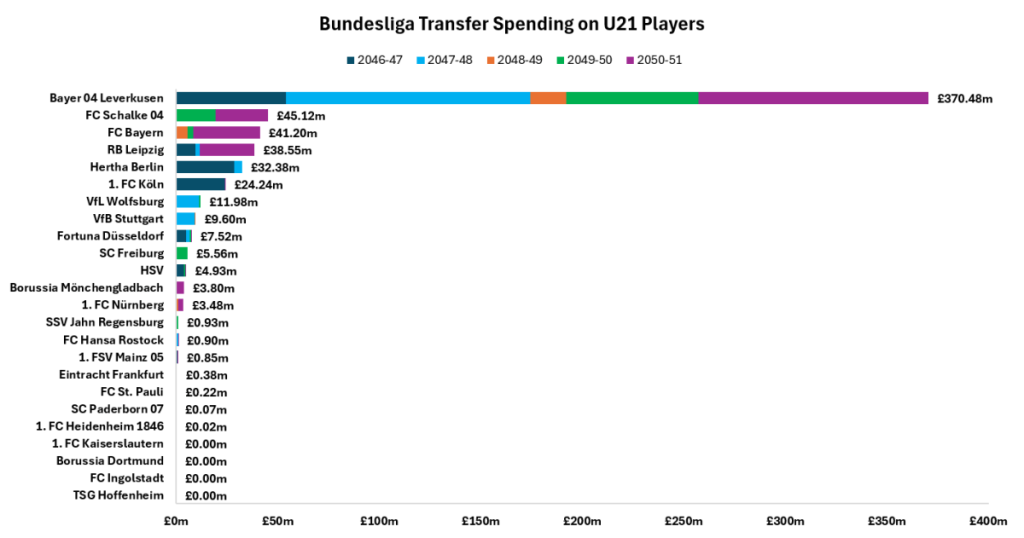
After reading an article from The Athletic about Newcastle United’s change in transfer policy, I was reminded of a previous graphic that I’d made looking at the Bundesliga spending on wages across different age groups. With PIF-run Newcastle putting greater focus on buying players under the age of twenty-one, I wondered how the transfer spending was targeted in the same way over the last five years in my FM save. Here’s the result:
There’s the obvious parallel between my Bayer 04 Leverkusen side and Chelsea in real life, at least until this transfer window for Chelsea. My spending on players aged twenty-one or under is over eight times greater than the next club, FC Schalke 04. Which begs the question:

Having said that, Chelsea’s approximate spending of £879 million across the previous five seasons and thirty players aged twenty-one or younger dwarfs my expenditure. With their total spending around £1.95bn over the same period (with the summer window still open at the time of writing), that’s around 45p in every £1 spent on players aged twenty-one or younger.
What drives my spending isn’t the same as Chelsea’s rather curious and somewhat eye-watering approach to transfers, in particular their above-stated spending as well as the extended contracts agreed with these players. It is instead based on a balance sheet and cash flows that are supported by the long-term success on the field across both domestic and European football.
As such, I’m able to afford to take risks on players who aren’t proven at the first team level yet and either loan them out to gain that experience or place them into the U19 team to receive dedicated training programmes to help them develop through individually focused roles and foci.
Other Bundesliga clubs with smaller transfer budgets perhaps can’t afford to take that risk when deciding upon their investment into squad building, instead favouring players with a higher current ability over greater potential ability of younger players.
However, this is where I think Football Manager gets this wrong too often.
We’ve seen clubs like Brighton reach the Premier League through player-trading models, where they’ve identified players who are undervalued by the market. According to The Athletic’s article, Brighton have spent £240.2m on players aged U21 over the past three years. These are young players, and through coaching them into better players and raising their profile, they have been or will likely be able to sell them on for typically far more than they bought them for. Moisés Caicedo would be the classic example, with Brighton signing him for £4m from Independiente del Valle aged nineteen before selling him on for £115m plus another £30m in potential add-ons to the aforementioned Chelsea. They did the same thing in signing John Paul van Hecke for up to £2.7m aged 20 from NAC Breda before selling him six years later to Tottenham for £52m this summer.
Caicedo’s transfer alone has allowed Brighton to spend again on new players and, to an extent, positively skews their £240.2m spending on new young players across the past three seasons, according to The Athletic’s article.
They rolled the dice, albeit in an educated way, on Caicedo, negotiated a high payoff and then did the same again on a series of players using the same process, in the hope that they would have yet more hits to achieve yet more success on the field and in their financial records.
And yet, as we can see, to a significant extent, AI clubs over the five-year period that I’ve looked at in my save simply don’t act like that.
There is a very limited amount of incoming transfers of young players identified by the clubs using a wide scouting network, and then playing them to develop them as players, either to sell them to other, larger clubs for profit or to improve them as a side.
When looking at each £1 spent on all transfers, through my instruction, my Director of Football has spent 45.64p on U21 players. Broadly similar to real-life Chelsea.
SC Freiburg (41.04p per £1) and 1. FC Nürnberg (31.79p per £1) came close, but that’s not the full story. When you consider that their total expenditure on incoming transfers was £13.53m and £10.95m, respectively, that translates into £5.55m and £3.48m. Our £811.65m and £370.48m on players aged twenty-one and under blow them out of the water.

Four teams, 1. FC Kaiserslautern, Borussia Dortmund, FC Ingolstadt and TSG Hoffenheim, didn’t spend a single pound on buying players aged twenty-one or under. There’s perhaps some logic in this for TSG Hoffenheim, 1. FC Kaiserslautern and FC Ingolstadt, given that they each had just one season in the Bundesliga over the period. It’s maybe better to spend what little you can, if anything, on experienced players to hope that you can avoid relegation.
For Borussia Dortmund to not spend anything at all on young players over a five-year period is frankly staggering. This is a club that signed Erling Braut Håland and both Jude and Jobe Bellingham when they were all under the age of twenty-one.
After further investigation into the total transfer spending on players of all ages and the average transfer spending per season spent in the Bundesliga over the last five-year period, Borussia Dortmund’s total spending ranked eleventh out of all clubs. It’s a clear sign that Borussia Dortmund are no longer a big club in terms of transfer spending power.

Looking into their transfer spend for the current season, they have only spent half their transfer budget of £22.5m. Yet, they have a net spend of just £0.5m and so still have the vast majority of their budget left. Therefore, that’s clearly not an excuse.
It seems natural to expect that there would be a need across the various positions to reduce the average age of the squad, and yet they’ve not done that at any point.
They even set up an affiliate club agreement with FK Crvena zvezda in 2041, which granted them first refusal on any of their players. This is a Serbian team famed for its good youth academy, and they do have some youth prospects in their senior and youth sides that could be interesting for a side like BVB in their current position. Yet, they’ve not activated this once in the last five years.
RB gives you a walking stick
Switching focus to another club in the Bundesliga, for RB Leipzig to have only spent 9.76% of their total spend on young players despite their real-life focus on recruiting young talents is also evidence that things aren’t as they should be.
In the lifetime of this save they’ve never had a board takeover, so I find it unlikely that they would want to change their existing club focus on signing young players like Yan Diomandé, Abdoul Koné, and Conrad Harder, all twenty-one or younger and signed within the last thirteen months in real life. They’ve developed Diomandé through giving him exposure to first-team football at a high level. Now, he is set for a big money transfer to Real Madrid after a single, standout season. They could pocket as much as €110 million profit on the deal if their rumoured asking price is reached.
Going back to the save game, were it not for this season where they spent £26.8m on players aged twenty-one or younger, curiously enough from me, their total spending would have only been £11.75m. That’s from a total spend of £360.80m across four seasons.
This is so far removed from their existing business model, purposefully signing players to develop and sell on, as well as fitting with their desire to fit with their overall brand of their energy drink that specifically targets young people.
This is further exemplified by this chart:

RB Leipzig has the third oldest playing squad weighted by the minutes played. This is very far removed from their real-life business model. Yes, they have some older players to guide and mentor the younger players, but their real-life weighted average age by minutes over the course of last season across all competitions was 24.42, according to data from FBref, and 9,658 minutes played in total by players aged twenty-one or younger. This equates to 25.67% of all minutes played.
It will be curious to see how they, 1. FC Köln, FC St. Pauli and Borussia Dortmund respond going forward to their ageing squads. My guess would be that they will simply continue to recruit older players to fill in the gaps, but perhaps RB Leipzig’s recent purchase of two of my young players points to a different direction than that? Time will only tell.
There is potentially a different explanation to this. Perhaps clubs are developing their own players through their youth academies such that they don’t need to sign young players.
Many of the Bundesliga clubs have highly rated academies and youth recruitment, which are matched with good Heads of Youth Development to lead that process, so this is possible.
In which case, we’d expect to see an abundance of players who are trained at the club and who have been playing considerable minutes for their side.
Let’s dig into the data and see what this tells us:

Here we see the total percentage of minutes played over the course of the current season (2050/51) up to the start of February. BVB’s academy now looks reasonable if we take the percentage of minutes played by homegrown at the club as a guide. 1. FC Nürnberg and Eintracht Frankfurt’s academies look to be exceptional.
It is worth noting that 1. FC Nürnberg are in the relegation playoff spot, having only just been promoted last year, so there is perhaps a budgetary decision to play players from their own academy. However, looking at their younger players who are trained at the club, it does look as though they’ve been generating some good youth prospects who are worthy of minutes for a lower-level Bundesliga club.
For Eintracht Frankfurt, the two players with the highest minutes played so far this season are both homegrown at club: twenty-two-year-old Daniel Doda, who looks to be a world-class centre back in he making, and his centre-back partner, nineteen-year-old Jürgen Thömmes.
The issue with the data used to create the above chart is that these are players of all ages. If we want to judge their willingness to play players who are aged twenty-one or younger, we need to take another step:

This chart demonstrated the number of players who are twenty-one or younger and trained at club (the orange dots) on the secondary y-axis and the total number of minutes played by those players (the respective columns) on the primary y-axis. Three clubs have zero players aged twenty-one or younger that are in the first team that are homegrown at the club, including my side. That goes up to four clubs when you look at the minutes that are played by the same age range.
If a club, like mine, is loaning out homegrown young players to gain experience, then that’s an acceptable pathway if they’re not yet good enough for the first team. However, on further investigation, this isn’t the case for BVB either.
Equally, they have an U19 side that is full of players, though most don’t look to be of any real immediate quality despite their exceptional academy coaching and youth recruitment, as well as excellent youth facilities to train these young players. Therefore, they aren’t generating good youth prospects, so it’s perhaps not surprising that they then aren’t playing them. Though this just further compounds their lack of spending on younger players to compensate for this.
VfL Wolfsburg is a really curious case of squad building. They have eleven players who have come through their academy in their first team squad out of a total of forty-four, and yet they’ve only given them a combined 305 minutes to two of them across the season thus far. Therefore, they aren’t actually giving them a proper chance to develop.
This highlights yet another set of issues. It points to the case that Wolfsburg are: A. hoarding players that are never going to be good enough for the first team (I’ve checked and this is the case) and thus using up some of their wage budget inefficiently; B. they’re not playing players that are young with high potential in favour of players that have a higher current potential and thus not enabling those younger players to develop, or C. a mixture of both.
If we break this down as a percentage of minutes played by those aged twenty-one and under, it looks like this:

Whilst FC St. Pauli lead the way here, the eagle-eyed amongst you will have noted that their share of percentage minutes played by homegrown players aged twenty-one and under was only 4.8%.
Their share of total minutes played by players aged twenty-one and under is largely due to a central defender that they’ve loaned in from my Bayer 04 Leverkusen side. This is great news for me, as Lukas Buck, one of my youth academy prospects, is their highest-ranked player by minutes played so far this season. Hopefully, he’ll be developing his attributes and current ability accordingly.
RB Leipzig’s 4.6% of minutes played isn’t close to the real-life figure of 25.67% from last season, which backs up the earlier data. Nor is BVB’s 0% close to their 12.46% (when they had a squad with a weighted average age by minutes played of 26.08 years).
If we break this down further by taking the wage expenditure of each club this season by various age brackets, we see again how AI clubs are prioritising wage expenditure towards experienced players who are at their peak, and in some cases perhaps too much on those that are beyond their peak.

There are justifiable reasons as to why we see a tilt like this towards experienced players, such as the fact that player wages rise as they improve.
Two clubs, Fortuna Düsseldorf and Borussia Dortmund (again), aren’t spending a penny on wages for players aged twenty-one or under.
RB Leipzig stand out once again here, with nearly 35% of their total wage expenditure going to players aged thirty or more. At the risk of restating my point, this simply wouldn’t be within keeping of their real-life business model.
The club that looks to have the most interesting data here out of all the clubs is that of 1. FSV Mainz 05. They have invested a considerable amount into transfer fees and wages when acquiring new players who are aged between twenty-two and twenty-five who look to have real talent. They’re not going for players that are too young to make a difference now, instead taking players that have had one hundred-plus appearances, like Luis Ballo-Allo (twenty-four and signed for £37m) and Mourad Anouar (twenty-two, signed for £16.25m), who are undervalued by the market and will be given the opportunity to play. They’ve also negotiated minimum fee release clauses for both players into their contrats, potentially locking in healthy profits.
This practice is reflected in their £121.5m in (simplified) profits from player trading over the same five-year period, exclusively from players bought and sold over that time frame. This would be more if it was extended beyond players who were bought pre-2047-48.
This is proof that the concept exists and can be applied by the AI when conducting transfers and squad building in-game; they just don’t do it enough.
The issue associated with poor AI strategy applied in the game over long-term saves is that it makes the game far too easy, particularly so should you choose to maximise your scouting setup and use the player database without hidden attributes. I admit to setting up the game in this way when I initially started the save in Football Manager 2023.
As the human manager, you can identify players with high current ability who your scouts believe to have high potential after assessing them very quickly because their attributes are already available to you, and should you have the budgets for the transfer and wages available to you, you can most likely sign them.
If you opt to manage in the Bundesliga, where there are no limitations on who you can sign in terms of movement of labour, beyond non-EU players not being able to join until they’re eighteen, then you almost certainly can.
Some will no doubt be thinking, ‘Well, you did start a save with attribute masking off, so of course this is what can happen’, but my point is that the AI doesn’t compensate for this by being more competitive in the transfer market.
Sure, you may have to fight off some of the big European clubs like PSG or Arsenal, but once you have a big enough war chest of a balance sheet, you can probably afford to pay wages well above market value to attract the best young players.
I’ve handed over transfer and wages negotiations to my Director of Football, and he is still typically able to sign players for fees that the AI considers appropriate for the player/our club, so why doesn’t it do the same for the AI-led clubs?
This is where I feel the game gets it wrong. From the standpoints of financial power and transfer strategies.
There needs to be more rivalry and more choices available for the players to choose from when deliberating over who to sign for, backed up by more realism in terms of financial firepower for clubs/better management of their finances through great levels of player trading, much like how clubs such as Brighton and Brentford have managed theirs.
To this end, the AI clubs need to be far more active outside of the transfer window than they already are. It’s rare for an AI team to make a bid on a player even if they’ve had long-term interest in a player when the transfer window isn’t open.
I appreciate that there are a great many tasks that those at Sports Interactive need to address, but I hope that this is one that they look to get right through an overhaul in terms of how the AI thinks and reacts to scouting, player targeting and acquisitions, as well as squad building by giving young players more of a chance if that is within the club’s DNA. I’m not expressly saying that this should be the case for all clubs, just those that typically adopt such a model, like RB Leipzig.
Here’s hoping that Football Manager 27 will be better than its iteration this year. If AI transfer behaviour isn’t high up the list of priorities, then that’s understandable given the critique of this version, but it needs to be on the list for an upgrade soon; otherwise, long-term saves will not be challenging until it is.
PakarPBN
A Private Blog Network (PBN) is a collection of websites that are controlled by a single individual or organization and used primarily to build backlinks to a “money site” in order to influence its ranking in search engines such as Google. The core idea behind a PBN is based on the importance of backlinks in Google’s ranking algorithm. Since Google views backlinks as signals of authority and trust, some website owners attempt to artificially create these signals through a controlled network of sites.
In a typical PBN setup, the owner acquires expired or aged domains that already have existing authority, backlinks, and history. These domains are rebuilt with new content and hosted separately, often using different IP addresses, hosting providers, themes, and ownership details to make them appear unrelated. Within the content published on these sites, links are strategically placed that point to the main website the owner wants to rank higher. By doing this, the owner attempts to pass link equity (also known as “link juice”) from the PBN sites to the target website.
The purpose of a PBN is to give the impression that the target website is naturally earning links from multiple independent sources. If done effectively, this can temporarily improve keyword rankings, increase organic visibility, and drive more traffic from search results.
Streaming Film
Nonton Film gratis
Jasa Backlink
Download Anime Batch