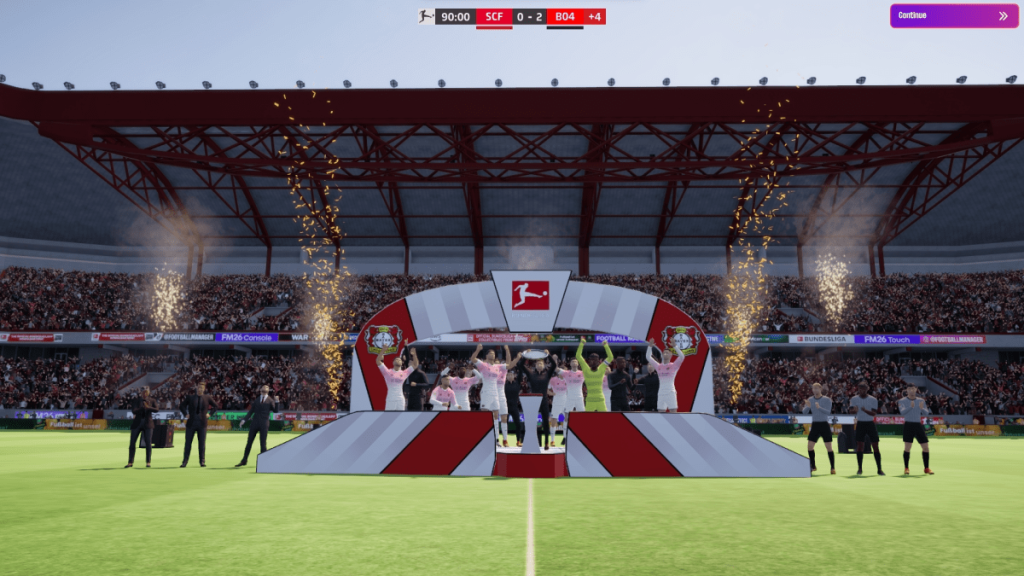

There were times when this should have been a formality and others when it was barely in reach. And yet, here we are; Bayer 04 are Bundesliga champions for the fifteenth time in a row.
A 2-0 victory away to SC Freiburg wouldn’t have mattered had Hansa Rostock been able to beat 1. FC Köln. Had that been the case, then they would have been the ones holding the trophy aloft.
The below graphic demonstrates the drop-off in total points compared to previous seasons. In any other season, Bayer 04 would have been fortunate to finish second. Even in the 2041-42 season when finishing tied on points with RB Leipzig, Bayer 04 still had control over their own destiny given the vastly superior goal difference, meaning that a last day loss didn’t matter.

As the season played out, four different teams led the Bundesliga after Week 10. Bayern and 1. FC Köln fell away, in Bayern’s case remarkably so, before a mini-revival to finish back in the European places. Yet, Hansa were always there or thereabouts right up until the final moments of their final game loss.

So how did this happen, and what can we do about it?
Defensive fragility
This first chart gives us an early indication. Our defensive capabilities were not what you should expect of a champion:

Our defence didn’t leak a huge number of chances, and an npxGA of 27.68 across the season vindicates this to a point – but we conceded 36 goals – 8.32 more than we were supposed to.
Comparing this to the previous season, our defensive collapse is self-evident. We conceded one more non-penalty goal on no fewer than seven occasions than our non-penalty goals indicated we should. This was five more than the previous season.
It became apparent very early into the season what the problem was. Our goalkeeper, Daniel Nwachukwu, began to show signs of ageing, no longer being the dominant force in goal that he had been in times gone by. His xG prevented per 90 was -0.46 – or 14.45 more goals conceded than he was expected to concede.
If you watch Mustermann’s “What does ‘GOOD’ look like?” video, you’ll soon realise that is disastrous. He saved only 72% of shots faced, ranking 16th out of 20 goalkeepers in the Bundesliga to make eight or more appearances in the league.
Scouts were sent out early on in the season to scour the market for alternatives, despite the knowledge that no-one the world over matches his attributes. Yann Diaby of FC Lorient looks an early standout and may be brought in to compete with Alperen Aslan and youth academy graduate Semih Mutlu.
Aslan was given an opportunity for a couple of Bundesliga games when it became apparent Nwachukwu was repeatedly performing below expectations. However, things were even worse when he played. His -2.40 xGP/90 over the two and a bit games he played, conceding 5 goals, or one goal every 30 minutes played was disasterous. He wasn’t much better in the DFB-Pokal games either, conceding 4 goals in 4 games despite two clean sheets – a 0.46 underperformance in terms of npxGP.
It certainly doesn’t seem likely that Nwachukwu’s replacement will come from within the Bundesliga. Here are the corresponding charts for all Bundesliga teams across the season showing their non-penalty goals against minus their non-penalty expected goals against:

Looking at the data, this was an annus horribilis for goalkeepers. Hoffenheim are the only standout team to have regularly conceded fewer goals than expected, finishing with 9.59 fewer goals conceded than expected. Even then, their goalkeeper, Mikkel Lauritsen, was in our youth academy for a time before he was sold, with his current ability not matching up to his initial potential.
This box-and-whisker chart demonstrates the plight for goalkeepers in the Bundesliga further. Seven outliers above the box plots and variance lines show they conceded more goals than even variance could explain, and only two occasions where the outliers indicate a potentially brilliant performance by the goalkeeper.

Hoffenheim show up here as the best-performing side but have a greater variance to the upper side of this with a significantly longer upper whisker. SC Freiburg’s bottom whisker is by far the longest, indicating that they had a number of games where they dramatically overperformed in terms of keeping the ball out of their goal when the statistics say that they should have conceded more. Opponents regularly missed big non-penalty chances against them, or they allowed numerous shots but from poor positions. This would need an xGA/shot study, but I’ve not collected that data.
When it comes to our data, the longer upper whisker again indicates our goalkeeping issues, although all the data can be explained by variance. It highlights our persistent ‘ability’ to concede goals we simply should not have and on a regular basis. The short lower whisker demonstrates that we rarely ever outperformed defensively. Given we have a relatively small box plot, it also tells you that this underperformance is consistent, unlike SC Freiburg and St Pauli, who just had a wild variance.
Attacking focus
What’s also noticeable is our home form dominance disappeared (red markers denote home games). On just six occasions did we beat our opponents by more than the upper quartile of 1.75 npxGD. Having said that, we managed to have an npxGD of more than 2 when playing away from home (blue markers) on three different occasions. Yet, HSV (relegated), Eintracht Frankfurt (relegation playoffs) and Hoffenheim (15th) were all weak teams.

Whilst the lower quartile was higher than the previous season, the upper quartile and median were both lower.
A significant part of that would likely be due to last season’s top goal scorer, Federico Parilla, facing months out due to two hip injuries that followed one another. He missed 58% of all possible minutes, but in actuality it was six months without him. Yet, he still found time to score 8 goals from an xG of 4.6.
Despite this, our attack wasn’t the issue over the course of the season. An xG of 75.7, which was actually marginally outperformed by 0.3, was nearly seven goals more than any other team. Hansa outperformed their xG of 50.44 by just over fifteen goals. That’s some overperformance over the course of a season. They should have finished sixth according to expected points, and RB Leipzig should have been second.
Squad transition
In response to the poor ratings our players were racking up at the start of the season, it was decided to go harder with the transition towards a younger team during the January transfer window. Emre Yüksel (Arsenal – £42.5m), Abdulrahman Monday (Real Madrid – loan with £32.5m mandatory future fee) and Piotr Woźniak (Real Madrid – £57m) were all sold in favour of more playing time for up-and-coming younger players Vasil Selimi and Boris Paillot.

In a concerted effort to readdress the issue of a lack of homegrown at club players, I purposefully kept some of the youngsters around. Those that are eligible for homegrown at club status have yellow rings around their marker. A yellow marker, which is only applicable to Restelli after the sale of Emre Yüksel, denotes already homegrown at club. Those in green are homegrown in nation.
We’ve agreed a transfer already for Ghanaian left back Musah Seidu from Olympique de Marseille for £66m fee with a view to replacing Enric Ballesté.
The sales of the aforementioned players also helped to better spread our wage spending across different age brackets:

We are still potentially spending too much on players aged over 29, but this is in part down to a distinct lack of available high-quality talent amongst the 21-24-year-old age bracket. This perhaps explains why other Bundesliga clubs have followed suit and allocated so little towards those aged below 24 years old. Even taking into consideration wage demands of younger players against older players, this is a big allocation of funds in the first teams towards ‘proven talent’.
RB Leipzig in particular continue to purchase older players, regularly from us, which explains their extreme wage expenditure towards those aged 29 and over. So much for the RB focus on youth in keeping with their brand.
With more to be done before the next season, including the small matter of the Club World Championship, this could be a very different side when the 2045-46 season comes along.
PakarPBN
A Private Blog Network (PBN) is a collection of websites that are controlled by a single individual or organization and used primarily to build backlinks to a “money site” in order to influence its ranking in search engines such as Google. The core idea behind a PBN is based on the importance of backlinks in Google’s ranking algorithm. Since Google views backlinks as signals of authority and trust, some website owners attempt to artificially create these signals through a controlled network of sites.
In a typical PBN setup, the owner acquires expired or aged domains that already have existing authority, backlinks, and history. These domains are rebuilt with new content and hosted separately, often using different IP addresses, hosting providers, themes, and ownership details to make them appear unrelated. Within the content published on these sites, links are strategically placed that point to the main website the owner wants to rank higher. By doing this, the owner attempts to pass link equity (also known as “link juice”) from the PBN sites to the target website.
The purpose of a PBN is to give the impression that the target website is naturally earning links from multiple independent sources. If done effectively, this can temporarily improve keyword rankings, increase organic visibility, and drive more traffic from search results.
Streaming Film
Nonton Film gratis
Jasa Backlink
Download Anime Batch