
Hello, everyone! Today, we will explore a particularly important topic: telling time in Portuguese. Did you know that Portuguese uses a different time system from the familiar AM/PM format? Additionally, there are multiple ways to express the same time in Portuguese. Are you confident in your ability to discuss time in Portuguese? And do you know how to say “time zone” in Portuguese? Join us as we learn and practice time and hours in Portuguese — all while having fun! Ah, once you feel safe, listen to our Time in Portuguese podcast at the end of this dica and practice even off-screen!
What time is it in Portuguese?
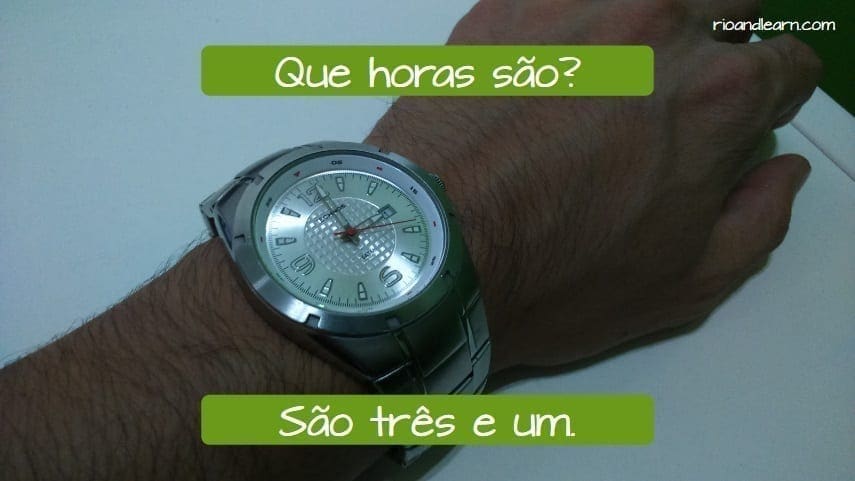
How do you say what time is it in Portuguese? There are several ways to tell time in Portuguese, but let’s start with the basics: the verb ser is always used to describe the hours. When asking for the time, we commonly use the expression “Que horas são?“. Here is an example of how this is used:
| Por favor, que horas são? | Please, what time is it? |  |
| São duas e quinze da tarde. (14:15) | It’s two fifteen in the afternoon. (2:15 pm) | |
In more informal, everyday conversations, you may also hear Brazilians ask “Tem horas?”. This expression is very common in spoken Portuguese and has the same meaning as Que horas são?, but sounds more casual — something you’d say to a friend, a colleague, or even a stranger on the street.
| Tem horas? | |
What time is it? |
Example:
Tem horas?
Do you have the time?
Tem, são três horas.
Yes, it’s three o’clock.
Both expressions are correct and widely used. Learning them together helps you sound more natural and understand Portuguese as it’s really spoken in Brazil.
Time, Seconds, Minutes and Hours in Portuguese
So, we already know how to say what time is it in Portuguese, but here is a basic vocabulary that we might miss when talking about time in Portuguese:
You’ll notice that of all these basic words, we frequently use just the last one. We don’t need to talk about seconds or minutes in Portuguese that much. And to talk about time, we use hours instead of tempo as you have just seen in our previous section titled what time is it in Portuguese.
Forget the am or pm time in Portuguese. How to Use the 24h Format?
Brazilians love to be exceptionally detailed when they speak! So, it’s common to hear someone specify the period of the day, even when it’s already clear from the context. In Brazil, the 24-hour clock format is typically used, and dates are written in the day/month/year format, in line with most international standards. This is why people don’t use AM/PM. Instead, there are two ways to describe the time of day:
Keep in mind: When Brazilians describe hours between one and eleven, they tend to add whether they mean in the morning or in the afternoon/night, so talking about time in Portuguese you don’t really need the am or pm format anymore!
Meia-Noite and Meio-Dia?
Against all expectations, Brazilians have a special and unique way of referring to 12:00 and 00:00. Take a look at the examples below so you can understand it better!
| Com licença! Tem horas? | |
Excuse me! Do you have the time? |
| É meio-dia. | |
It’s midday / It’s noon. (12:00 pm) |
Notice that Tem horas? is another way to say what time is it in Portuguese!
| A que horas você chegou em casa ontem? | |
What time did you get home yesterday? |
| Mais ou menos meia-noite. | |
About midnight. (0:00 am) |
Let’s listen to the expressions we just learned.
Punctual Time in Portuguese

When people want to say round hours such as 8h00 or 16h00, they use the expression em ponto (o’clock) or they complete with the word horas.
| A que horas começam as aulas na Rio & Learn? | |
What time do classes start at Rio & Learn? |
| As aulas começam às nove horas em ponto. | |
The classes start at nine o´clock. |
In this example you could answer as well with:
As aulas começam às nove horas.
or
As aulas começam ás nove em ponto.
With em ponto in Portuguese, you emphasize that it will be punctual.
| em ponto | |
o’clock / on time |
Be aware that if you do Portuguese online group classes with us, we have three different time schedules to adapt to your current time zone. Even though we are Brazilians, if you study at Rio & Learn classes start em ponto!!
E Meia in Portuguese
Another way of saying the time in Portuguese is when you want to be more specific than just describing the whole hour. When it is ‘half past’ a certain hour, we say e meia in Portuguese. If you want to read more about this, check out our Dica about the different uses for the word meia.
| Você sabe a que horas vai começar o show? | |
Do you know when the concert starts? |
| Vai começar às dez e meia. (22:30) | |
It starts at half past ten. (10:30 pm). |
We can’t say dez e meia horas, but you can say dez e meia da manhã or dez e meia da noite.
| e meia | |
half past |
Other Hours in Portuguese
So, we already know how to talk about the o’clock hours and half past hours, but what about any other time? It’s easy, in Brazil we don’t use quarters, so it can be easier as it is one less thing to think about. Let’s see the expressions left for us to learn related to all the other Brazilian Portuguese hours that we didn’t cover:
Ok, that can be complicated, but let’s see it with examples to make it clear:
10:10h: São as dez e dez.
It’s ten ten.
10:15h: São as dez e quinze.
It’s ten fifteen.
10:25h: São as dez e vinte e cinco.
It’s ten twenty-five.
10:40h: São vinte para as onze.
It’s twenty to eleven.
10:50h: São quinze para as onze
It’s ten to eleven.
10:55h: São cinco para as onze.
It’s five to eleven.
So, you can see that in the first 29 minutes of the hour, we use one structure and in the last 29 minutes before the hour change we use another structure with para as. As you can see, knowing the numbers is crucial to master the hours. Learn the numbers from 1 to 29 with our Dica about numbers in Portuguese!
As we mentioned before, notice in the examples that in Brazil we don’t use quarters. Also, we use para a instead of para as when we refer to the 29 minutes before 1 am, 1 pm, and midnight. Check it out:
12:45h: São quinze para a uma da tarde.
23h35: São vinte e cinco para a meia-noite.
We use para o instead of para a when we refer to the 29 minutes before midday. See how to do it:
11h40: São vinte para o meio-dia.
11h55: São cinco para o meio-dia.
If you feel like you don’t completely understand the use of these para as, para o and para a, we recommend you to review our Dica about para in Portuguese.

Faltam instead of São
When we use para as, para a and para o, so when we talk about the last half of an hour, it is possible to use faltam instead of são. See again the last 7 examples that we just saw before, but now with faltam instead of são:
10:40h: Faltam vinte para as onze.
It’s twenty to eleven.
10:50h: Faltam quinze para as onze
It’s fifteen to eleven.
10:55h: Faltam cinco para as onze.
It’s five to eleven.
12:45h: Faltam quinze para a uma da trade.
It’s five to one pm.
23h35: Faltam vinte e cinco para a meia-noite.
It’s twenty-five to midnight.
11h40: Faltam vinte para o meio-dia.
It’s twenty to midday/noon.
11h55: Faltam cinco para o meio-dia.
It’s five to midday/noon.
At what time in Portuguese
The phrase “at what time” in Portuguese is translated as a que horas. It’s used when you want to ask or refer to a specific time something will happen.
Example on how to use at what time in Portuguese
- Portuguese:
– A que horas começa o filme?
– O filme começa às 7 horas. - English:
– At what time does the movie start?
– The movie starts at 7 o’clock.
Key points:
- “A que horas” is commonly followed by a verb, like “começa” (starts), “abre” (opens), or “fecha” (closes).
- To answer the question, you would typically use “às” (at), followed by the time.
Example:
- Question: “A que horas você vai chegar?”
- Answer: “Vou chegar às 8 horas.”
This is the equivalent of asking “What time are you going to arrive?” and answering “I will arrive at 8 o’clock.”

At what time in Brazil
But, if you already know us, you know that we like informality! So, in Brazil, it is more common to forget the a before a que horas and we use much more “Que horas?” So, let’s rephrase the same first example:
- Portuguese:
– Que horas começa o filme?
– O filme começa às 7 horas. - English:
– At what time does the movie start?
– The movie starts at 7 o’clock.
At what time Pronunciation in Portuguese
Let’s see how we pronounce at what time in Portuguese:
| A que horas? | |
At what time? |
| Que horas? | |
At what time? |
Lunch Time in Portuguese
But talking about time, we can’t forget about the most desired time for Brazilian workers, lunch time in Portuguese. We love to be very punctual or to have lunch early unlike on the weekends when we are usually relaxed and we can have lunchtime late. In Portuguese, “lunchtime” is referred to as “hora do almoço”. In Brazil, lunch is often considered the most important meal of the day.
Key expressions related to lunch time in Portuguese:
- Hora do almoço – Lunch time
Example: “A hora do almoço é ao meio-dia.”
Translation: “Lunch time is at noon.” - Almoçar – To have lunch
Example: “Vamos almoçar às 13 horas?”
Translation: “Shall we have lunch at 1 PM?” - Intervalo para o almoço – Lunch break
Example: “O intervalo para o almoço é das 12 às 13 horas.”
Translation: “The lunch break is from 12 to 1 PM.”
Lunch time Vocabulary and Pronunciation in Portuguese
Typical lunch times in Brazil
- In Brazil, lunch usually happens between 12 PM and 2 PM, but it can vary depending on work schedules or regional customs.
Example:
“Eu normalmente almoço às 12h30.”
Translation: “I usually have lunch at 12:30 PM.”
Examples of Time in Portuguese
See now some examples of everything that we’ve just learned:
Minha aula online de Português começa às oito da manhã.
My online Portuguese class starts at 8 am.
Paula chegou em casa às quatro da tarde no sábado.
Paula arrived home at 4 pm on Saturday.
Seu ônibus vai partir às 23 horas.
Your bus will leave at 11 pm.
A RioLIVE! de hoje vai começar às quinze para as três. (14:45)
The RioLIVE! is going to be at a quarter to three. (2:45 pm)
O avião vai partir do Rio de Janeiro às dez para a meia-noite. (23:50)
The plane leaves Rio de Janeiro at ten to midnight. (11:50 pm)
So do you feel you already dominate time in Portuguese enough to let go of the AM/PM format forever?
Time Zone in Portuguese
Brazil has four different time zones in the same country, so it is important to know how to say time zone in Portuguese:
| o fuso horário | |
time zone |
Let’s see an example using time zone in Portuguese:
Exemplo:
Quando viajei de São Paulo para Fernando de Noronha, tive que ajustar meu relógio porque o fuso horário lá é diferente. São Paulo está no fuso horário UTC-3, enquanto Fernando de Noronha está no fuso horário UTC-2.
Tradução:
When I traveled from São Paulo to Fernando de Noronha, I had to adjust my watch because the time zone there is different. São Paulo is in the UTC-3 time zone, while Fernando de Noronha is in the UTC-2 time zone.
Listen, Feel, and Practice: Time in Portuguese Podcast
You’ve learned how to talk about time in Portuguese — now it’s time to hear it come to life. In this podcast episode, we use the same expressions you just studied to show how Brazilians really talk about schedules, delays, plans, and everyday routines.
And if you want to challenge yourself even more, you can also listen to this episode in our Portuguese-only podcast for full immersion. If your native language is not English, we have as well our Spanish and French versions. Choose the one that fits your level, press play, and let Portuguese flow naturally — because learning time in Portuguese is much more fun when you hear it in real life.
Exercises for Time in Portuguese
Let’s see if you know how to tell time in Portuguese. Can you unscramble the sentences below and form the correct sentences about hours in Portuguese?
Did you know that our Dicas are always out at nine o’clock in the morning, Rio time? If you have more doubts, send a tweet to our Twitter account and it will be a pleasure to answer them! Now you know how to say time in Portuguese without am or pm! But did you know you can have Portuguese online classes wherever your time zone is?
See you soon!
Kisses from Rio & Learn!
Click on the links below to see more related Dicas
Numbers from 1 to 10 in Portuguese
Numbers from 11 to 20 in Portuguese
Dates in Portuguese
Ser in Present Tense in Portuguese

Online Academic Coordinator at Rio & Learn Portuguese School.
Experienced educational coordinator and teacher since 2007, adept in curriculum development, creating physical and digital educational materials, and leveraging online platforms to enhance learning outcomes
Berita Terkini
Berita Terbaru
Daftar Terbaru
News
Berita Terbaru
Flash News
RuangJP
Pemilu
Berita Terkini
Prediksi Bola
Technology
Otomotif
Berita Terbaru
Teknologi
Berita terkini
Berita Pemilu
Berita Teknologi
Hiburan
master Slote
Berita Terkini
Pendidikan
Resep
Cek Ongkir Cargo
Togel Deposit Pulsa
Daftar Judi Slot Online Terpercaya
Slot yang lagi gacor
