
What can one avenue tell you about a city?
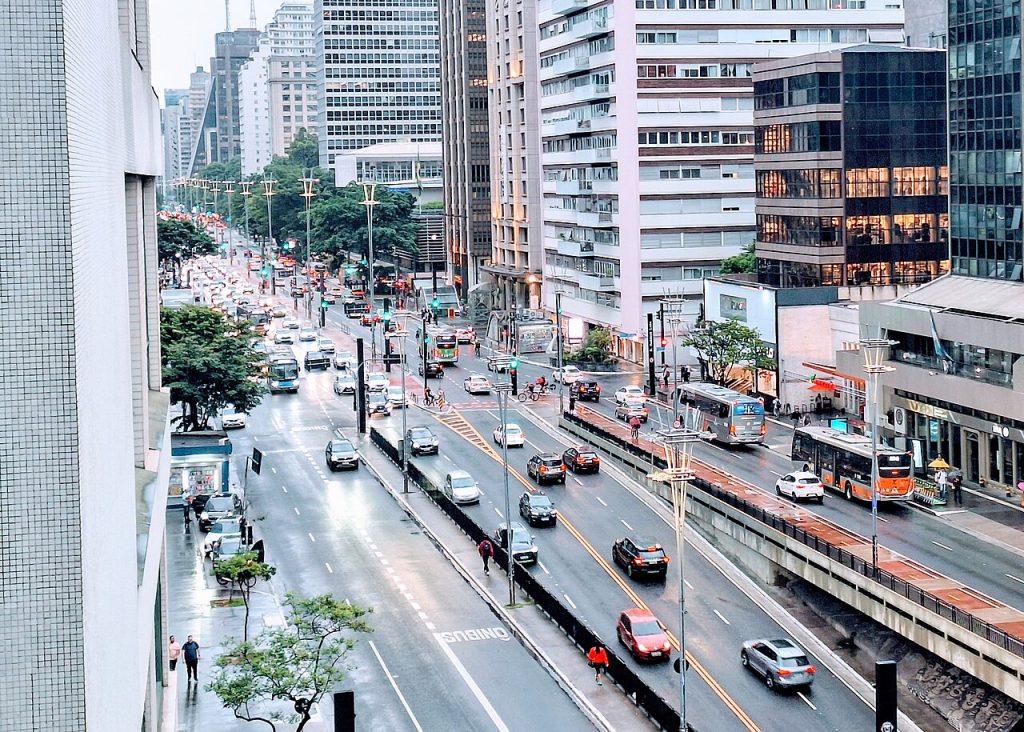
In São Paulo, Avenida Paulista tells you a lot. It brings together banks, museums, metro stations, bookstores, hospitals, shopping centers, office workers, students, tourists, street artists, protests, and Sunday crowds in one of Brazil’s busiest urban corridors.
Avenida Paulista is not famous because it is pretty in a simple postcard way. It is famous because it shows São Paulo working in real time. People rush to meetings, friends meet for coffee, museums open their doors, cyclists take over the street on Sundays, and public events bring thousands of people into the same space.
Why Avenida Paulista Matters So Much
Avenida Paulista was inaugurated on December 8, 1891, when São Paulo was expanding rapidly. At the time, it was associated with São Paulo’s coffee elite and designed as an elegant residential avenue. Over the decades, the mansions gave way to office towers, banks, cultural centers, shopping areas, apartment buildings, museums, bookstores, cafés, and metro stations.
That change explains a lot about São Paulo itself. The city grew from a coffee-powered regional capital into Brazil’s largest business center, and Avenida Paulista followed the same path. It stopped being only an address for wealthy families and became a public corridor where money, culture, transport, tourism, and everyday life cross paths.
This is where business and art meet in a very practical way. You can see someone in a suit walking past a musician, a tourist taking photos, a student heading to class, a couple going to MASP, and a group of friends choosing where to eat. The avenue is busy, mixed, and sometimes chaotic, but that is exactly why it feels so connected to the city around it.
And when you understand Portuguese, those small scenes become easier to read, especially in a city where business, culture, and daily life are so closely connected. Rio & Learn’s online Portuguese classes can help you build confidence for meetings, emails, presentations, networking, and everyday conversations with Brazilian colleagues and clients. Avenida Paulista may be in São Paulo, but business Portuguese can travel with you wherever you work.
Avenida Paulista and São Paulo’s Global Identity
São Paulo is a city built by movement. People arrived from other parts of Brazil and from countries around the world, bringing languages, food, religions, work, art, and family histories with them. Avenida Paulista reflects that mix better than almost anywhere else in the city.
A walk along the avenue shows a city shaped by Italian, Japanese, Arab, Portuguese, African, Indigenous, and Northeastern Brazilian influences, all sharing the same urban space. São Paulo is especially famous for its large Japanese-Brazilian community, one of the most important outside Japan, and that connection appears clearly on Avenida Paulista through places like Japan House São Paulo.
That is what gives Avenida Paulista its energy. A businessperson, a student, a street musician, a tourist, a family visiting a museum, and friends deciding where to eat can all pass through the same avenue in the same afternoon. It is not a perfect version of Brazil created for visitors. It is city life, with noise, speed, diversity, work, culture, and surprise sharing the same sidewalk.
What to See on Avenida Paulista
Avenida Paulista is not only a place to walk through. Around the avenue, you can move from MASP’s modernist structure to the trees of Parque Trianon, the preserved mansion of Casa das Rosas, and the Japanese-Brazilian cultural connection at Japan House São Paulo. Together, these places show why the street became one of the city’s main cultural routes.
MASP: Art Floating Above the Avenue
One of the most famous landmarks on Avenida Paulista is MASP, the São Paulo Museum of Art, which moved to its current Lina Bo Bardi-designed building in 1968. The building is impossible to miss: a large red structure holds the museum above an open space that has become a meeting point, photo spot, market area, and public gathering place.

MASP is one of the most important art museums in Brazil and a major cultural stop on Avenida Paulista. It connects São Paulo to Brazilian and international art, but it also works as part of the city’s daily geography. People use it as a reference point, a meeting place, and a starting point for walking along the avenue.
Parque Trianon: Green Space in the Middle of the City
Right across from MASP, Parque Trianon offers a completely different experience. After the traffic, glass buildings, and city noise, the park gives you trees, shade, birds, and a small pocket of calm. The contrast is one of the best things about this part of Avenida Paulista: museum and park, concrete and green space, movement and pause.
For visitors, it also changes the pace of the walk. You can cross from MASP into the park, sit for a few minutes, and feel how sharply São Paulo can shift from concrete to green space without leaving Avenida Paulista.

Casa das Rosas and Avenida Paulista’s Past
Built in 1935, Casa das Rosas is one of the few remaining buildings from Avenida Paulista’s residential phase. Its architecture gives visitors a rare glimpse of the time when mansions, gardens, and wealthy families shaped the avenue’s image.
Today, Casa das Rosas is connected to literature, poetry, exhibitions, and cultural events. That makes the building more than a preserved mansion. It is a place where the old residential Avenida Paulista has been turned into a cultural space for the city.
Avenida Paulista does not erase its past completely. It keeps small pieces of it between towers, traffic, cafés, museums, and metro stations.

Japan House São Paulo and Japanese-Brazilian Culture
Another important cultural space on Avenida Paulista is Japan House São Paulo. This center presents Japanese art, culture, design, science, technology, tourism, education, and creative exchange.
Its presence on Avenida Paulista is not random. São Paulo is famous for its large Japanese-Brazilian community, and Japanese influence is part of the city’s food, family histories, neighborhoods, festivals, and cultural life. Japan House brings that connection into one of the city’s most visible public spaces.
For visitors, this is a useful reminder that Brazilian culture is not one single story. On Avenida Paulista, Brazil appears through migration, mixture, work, memory, and reinvention. That is part of what makes São Paulo different from any other city in the country.

Sunday on Avenida Paulista
During the week, Avenida Paulista works like a business and transport artery. People arrive by metro, walk quickly between appointments, enter office buildings, stop for lunch, and move through the avenue with purpose.
On Sundays and holidays, Avenida Paulista is usually closed to cars and opened to pedestrians through the city’s Ruas Abertas program. The change is easy to notice. Families walk in the middle of the street, children ride bikes, musicians perform, couples stroll, street vendors sell snacks and drinks, and the asphalt becomes public space.
Sunday on Avenida Paulista is one of the best ways to see São Paulo outside the office-hour rhythm. You can visit MASP, cross to Parque Trianon, stop for coffee, listen to street music, explore cultural centers, and watch how people use the city when cars are no longer in control of the avenue.
Avenida Paulista is also practical. There are hotels, restaurants, cafés, bookstores, cinemas, shopping centers, pharmacies, banks, and plenty of places to meet friends. But the most interesting part is how those everyday places become part of the avenue’s character.
You might stop at Shopping Center 3, walk through Conjunto Nacional, look for a bookstore, grab a coffee, eat pizza nearby, or buy a quick snack before heading to a museum. None of that sounds extraordinary on its own, but together these stops show how people actually use Avenida Paulista.
Buying pão de queijo, asking for directions, ordering coffee, reading signs in Portuguese, and hearing people talk around you are tiny windows into Brazilian life. For language learners, these moments matter because they turn Portuguese from a classroom subject into something useful, social, and immediate.
Avenida Paulista as a Stage for Brazil
Avenida Paulista is one of Brazil’s most visible public stages. Major celebrations, parades, demonstrations, cultural events, and political gatherings often happen there because the avenue is central, symbolic, accessible, and instantly recognizable.
That does not mean every visit is dramatic. Most days are simply busy, loud, and practical. But the avenue has symbolic power. When São Paulo wants to celebrate, protest, gather, or make itself seen, Avenida Paulista often becomes part of the story.
This public role is part of what separates Avenida Paulista from an ordinary commercial street. It is not only a place to pass through. It is a place where the city appears in public, sometimes festive, sometimes political, sometimes tense, and often unforgettable.

Avenida Paulista: More Than a Famous Street
For some visitors, Avenida Paulista is a museum day. For others, it is a Sunday walk, a shopping stop, a business address, a metro connection, or a place to meet friends. For São Paulo, it is all of that at once.
When you visit São Paulo, do not treat Avenida Paulista as just a point on the map. Walk it. Look up at the buildings. Step into the museums. Rest under the trees at Parque Trianon. Visit Casa das Rosas. Explore Japan House São Paulo. Listen to the languages, accents, music, traffic, and conversations around you.
Brazil becomes easier to understand when you notice its different rhythms. Rio invites you to feel the country through the beach, the mountains, and the sea. São Paulo invites you to feel it through movement, scale, work, culture, and city life.
Avenida Paulista is one of the clearest places to see that side of Brazil in motion.
Click on the links below to see more related Dicas
São Paulo
São Paulo FC
MITsp
Japanese in Brazil

SEO Content Specialist at Rio & Learn Portuguese School. A native English speaker who arrived in Brazil six months ago and quickly fell in love with the country, Tom focuses exclusively on Brazil-focused content. He combines data-driven keyword research with careful fact-checking in collaboration with Rio & Learn’s Brazilian teachers.
PakarPBN
A Private Blog Network (PBN) is a collection of websites that are controlled by a single individual or organization and used primarily to build backlinks to a “money site” in order to influence its ranking in search engines such as Google. The core idea behind a PBN is based on the importance of backlinks in Google’s ranking algorithm. Since Google views backlinks as signals of authority and trust, some website owners attempt to artificially create these signals through a controlled network of sites.
In a typical PBN setup, the owner acquires expired or aged domains that already have existing authority, backlinks, and history. These domains are rebuilt with new content and hosted separately, often using different IP addresses, hosting providers, themes, and ownership details to make them appear unrelated. Within the content published on these sites, links are strategically placed that point to the main website the owner wants to rank higher. By doing this, the owner attempts to pass link equity (also known as “link juice”) from the PBN sites to the target website.
The purpose of a PBN is to give the impression that the target website is naturally earning links from multiple independent sources. If done effectively, this can temporarily improve keyword rankings, increase organic visibility, and drive more traffic from search results.