
Hi, galera! How are you?
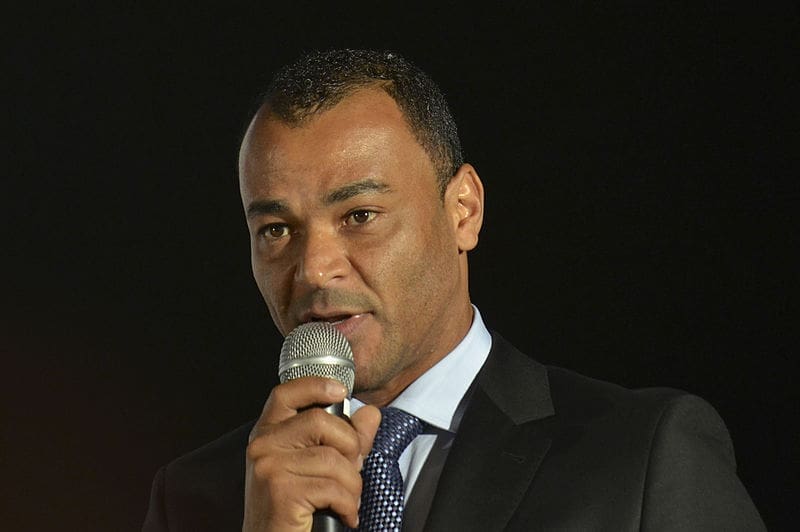
Imagine this scene: Brazil has just won the 2002 World Cup. Millions of Brazilians are celebrating, the players are jumping with joy, and Cafu, the captain of the Seleção Brasileira, walks up to lift the trophy.
But before raising the World Cup, he shouted something that became unforgettable in Brazil:
Regina, eu te amo!
Regina, I love you!
Beautiful, right?
Regina is Cafu’s wife, and this emotional phrase made millions of Brazilians smile. But Cafu’s story is much bigger than one famous sentence. He was rejected many times, kept running, became one of the greatest right-backs in football history, and captained Brazil during one of the happiest football moments in our country.
By the way, if Cafu’s story makes you want to understand the words Brazilians shout during a match, take a look at our Dica about football in Portuguese.
Quick Facts About Cafu
| Fact | Detail |
|---|---|
| Full name | Marcos Evangelista de Morais |
| Known as | Cafu |
| Date of birth | June 7, 1970 |
| Place of birth | São Paulo, Brazil |
| Position | Right-back |
| Main clubs | São Paulo, Roma, AC Milan |
| Brazil appearances | 142 |
| World Cups played | 1994, 1998, 2002, 2006 |
| World Cups won | 1994 and 2002 |
| Most iconic moment | Lifting the 2002 World Cup as Brazil captain |
Cafu’s Club Career
From Rejection to São Paulo
Marcos Evangelista de Morais was born on June 7th, 1970, in Itaquaquecetuba, a city in São Paulo state, and grew up connected to Jardim Irene, in São Paulo’s south zone. The football player became known around the world as Cafu. He became famous as a right-back, but his background on the right wing helped shape the attacking style that later made him famous in Brazil and Europe.
Before he became a World Cup captain, Cafu was reportedly rejected by nine clubs during tryouts. He was not treated like an obvious future superstar. His career had to be built through persistence.

Cafu started his professional career with São Paulo FC, where he became part of one of the strongest teams in South America. With São Paulo, he won the Campeonato Brasileiro in 1991, the Copa Libertadores in 1992 and 1993, and the Intercontinental Cup in 1992 and 1993. In 1994, after his success with São Paulo and Brazil, Cafu was named South American Footballer of the Year.
After leaving São Paulo, Cafu had a short spell with Real Zaragoza in Spain, where he won the UEFA Cup Winners’ Cup in 1994–95. He then returned to Brazil with Palmeiras, winning the Campeonato Paulista in 1996, before moving to Roma in 1997.
Roma: Where Cafu Became Il Pendolino
After successful years in Brazil, Cafu moved to Europe and joined Roma in 1997, where he played for six seasons.
At Roma, Cafu’s attacking style became famous in Italy. He did not play like a traditional full-back who stayed deep in defense. He moved constantly up and down the right side, defending when Roma were under pressure and joining attacks with speed and stamina.
In Italy, he earned the nickname Il Pendolino, inspired by the Italian express train.
And honestly, what a perfect nickname. Cafu really played like a train on the right side: always moving, always attacking, always coming back to defend.
In 2001, Cafu helped Roma win Serie A, one of the biggest achievements in the club’s modern history. That Roma side also included stars such as Francesco Totti, Gabriel Batistuta, and Vincenzo Montella. Cafu gave the team width and energy on the right side, helping balance a team full of attacking talent. For Roma fans, he became part of a title-winning team they would never forget.
Watch some of Cafu’s best highlights here:
Milan: The Veteran Who Still Won Everything
In 2003, Cafu left Roma and joined AC Milan. By then, he was already in his thirties. For many footballers, that is when speed and energy begin to fade. Cafu, however, continued to play at the highest level.
Cafu became an important part of Milan’s squad, making 166 appearances for the club and scoring 4 goals. Most of those games came in Serie A, where he played 119 matches for Milan.
With AC Milan, he won Serie A in 2003–04, the Italian Super Cup, the UEFA Champions League in 2006–07, the UEFA Super Cup, and the FIFA Club World Cup.
The Champions League was an important part of his Milan story. Cafu played in the 2005 final, when Milan lost to Liverpool after one of the most famous comebacks in football history. Two years later, Milan beat Liverpool 2–1 in Athens, and Cafu finally added the Champions League to his trophy list.
Cafu’s importance to both Italian clubs was later recognized when he was honored in the Roma and AC Milan Halls of Fame.
Cafu and Brazil: The Record That Defines Him
Cafu made his Brazil debut in 1990, in a friendly against Spain. Over the next 16 years, he played in four World Cups: 1994, 1998, 2002, and 2006. He won two of them, in 1994 and 2002, and became Brazil’s most-capped men’s player with 142 appearances and 5 goals for the national team.
He also played 20 World Cup matches, more than any other Brazilian player, and held the record for most World Cup match wins by a player, with 16 victories, before Miroslav Klose passed him in 2014. His most famous record is even harder to repeat: Cafu is the only player to appear in three consecutive World Cup finals.
In 1994, Cafu began the tournament as a substitute. In the final against Italy, Jorginho got injured in the first half, and Cafu came on after only 22 minutes. Brazil won on penalties, and Cafu became a World Cup champion. In 1998, he started the final against France, but Brazil lost 3–0. In 2002, he returned to the final again, this time as captain. Brazil beat Germany 2–0, and Cafu became the player who lifted the trophy.
His success with Brazil was not limited to the World Cup. Cafu also won the Copa América twice, in 1997 and 1999, and the FIFA Confederations Cup in 1997. Many Brazilian players are remembered for one unforgettable World Cup. Cafu is different. He connects an entire era of Brazilian football, from the champions of 1994 to the finalists of 1998 and the champions of 2002.
The Captain Who Was Not Supposed to Be Captain
One of the most interesting parts of Cafu’s 2002 World Cup story is that he was not originally expected to be Brazil’s captain. Before the tournament, the captain was supposed to be Emerson. But Emerson injured his shoulder in training just before the World Cup began, and Cafu received the armband.
That injury put Cafu in charge of a team full of stars, including Ronaldo, Rivaldo, Ronaldinho, Roberto Carlos, and Kaká. Cafu played every match of the tournament, and when Brazil beat Germany 2–0 in the final, he was the player who walked up to receive the trophy.
That moment turned him from a great Brazilian player into one of the defining images of Brazil’s fifth World Cup title.
Cafu’s Most Famous Words
The 2002 trophy lift became even more memorable because of what Cafu shouted before raising the cup:
“Regina, eu te amo!”
“Regina, I love you!”
Regina is Cafu’s wife, and the phrase became unforgettable because it was so personal. Brazil was celebrating its fifth World Cup title, millions of people were watching around the world, and Cafu used the biggest moment of his career to speak directly to his wife.
Cafu also used that moment to remember where he came from. Under his Brazil shirt, he carried the message:
“100% Jardim Irene”
Jardim Irene is the neighborhood in São Paulo connected to Cafu’s roots. So the trophy lift was not only about football. It was also about family, home, and the long journey from his beginning to the top of the world.
Watch Cafu lift the World Cup trophy for Brazil:
Cafu’s Trophies and Biggest Victories
Cafu won major titles with clubs in Brazil and Europe, as well as with the Brazilian national team.
| Team | Major achievements |
|---|---|
| São Paulo | Campeonato Brasileiro, Campeonato Paulista, Copa Libertadores, Recopa Sudamericana, Intercontinental Cup |
| Real Zaragoza | UEFA Cup Winners’ Cup |
| Palmeiras | Campeonato Paulista |
| Brazil | FIFA World Cup, Copa América, FIFA Confederations Cup |
| Roma | Serie A, Supercoppa Italiana |
| AC Milan | Serie A, Supercoppa Italiana, UEFA Champions League, UEFA Super Cup, FIFA Club World Cup |
Cafu’s trophy list is unusual because it crosses almost every major level of football. He won the Copa Libertadores and Intercontinental Cup with São Paulo, the UEFA Cup Winners’ Cup with Zaragoza, Serie A with Roma and Milan, the Champions League with Milan, and the World Cup with Brazil.
Cafu Today
After retiring from professional football in 2008, Cafu remained active in the football world.
He has worked as a football ambassador, including with Qatar’s Supreme Committee for Delivery & Legacy before the 2022 World Cup. In that role, he was connected to projects such as Josoor Institute, which focuses on education and development in the sports and events industries.
Cafu also continues to appear at international football events, legends matches, interviews, and campaigns connected to the World Cup. Because he was the captain of Brazil’s 2002 team, he is still regularly invited to represent that generation of Brazilian football.
In Brazil, Cafu has also developed projects connected to sport and education. In 2025, reports described the launch of Cafu Academy Brasil in Taboão da Serra, a project focused on football, education, citizenship, and opportunities for children and teenagers.
This connection between football, education, and community work also appears in one of the most important projects linked to his name: Fundação Cafu.
Fundação Cafu: Giving Back to Jardim Irene
Jardim Irene remained important in Cafu’s life after the 2002 World Cup.
After becoming world champion, he created Fundação Cafu in Jardim Irene, the neighborhood in São Paulo where he grew up. The project was created to support children, teenagers, and families from the community through sport, education, culture, and professional training.
The foundation was not only about football. Reports described activities such as ballet, capoeira, guitar, basketball, volleyball, crafts, computer access, and professional courses. Cafu said in an interview that many people thought the project was just football classes, but its real mission was social inclusion.
At its strongest point, Fundação Cafu reportedly helped hundreds of children and teenagers from Jardim Irene and nearby areas. Some reports said the project supported as many as 950 children and teenagers through sport, education, culture, and professional training.
The project later faced financial problems and announced the end of its activities in 2019 after 16 years of work. Even so, Fundação Cafu remains an important part of Cafu’s story because it shows how strongly his public image is connected to Jardim Irene.
Cafu’s Legacy
Cafu’s career is easy to remember through big numbers: 142 games for Brazil, four World Cups played, three World Cup finals, two World Cup titles, a Champions League title, and major trophies in Brazil and Italy.
But his story is stronger than a list of achievements.
From rejection to São Paulo, from Jardim Irene to the World Cup trophy, Cafu carried his roots all the way to the top of world football.
And through Fundação Cafu, his connection to Jardim Irene continued, giving back to the community through sport, education, culture, and professional training.
That is why Cafu remains one of the most respected players in Brazilian football history: not only because he won, but because he never forgot where he came from.
Hugs from Rio de Janeiro!
Click on the links below and see more related Dicas
Football in Portuguese
Most Important Football Teams in Rio
Ronaldo Brazilian Soccer Player

SEO Content Specialist at Rio & Learn Portuguese School. A native English speaker who arrived in Brazil six months ago and quickly fell in love with the country, Tom focuses exclusively on Brazil-focused content. He combines data-driven keyword research with careful fact-checking in collaboration with Rio & Learn’s Brazilian teachers.
PakarPBN
A Private Blog Network (PBN) is a collection of websites that are controlled by a single individual or organization and used primarily to build backlinks to a “money site” in order to influence its ranking in search engines such as Google. The core idea behind a PBN is based on the importance of backlinks in Google’s ranking algorithm. Since Google views backlinks as signals of authority and trust, some website owners attempt to artificially create these signals through a controlled network of sites.
In a typical PBN setup, the owner acquires expired or aged domains that already have existing authority, backlinks, and history. These domains are rebuilt with new content and hosted separately, often using different IP addresses, hosting providers, themes, and ownership details to make them appear unrelated. Within the content published on these sites, links are strategically placed that point to the main website the owner wants to rank higher. By doing this, the owner attempts to pass link equity (also known as “link juice”) from the PBN sites to the target website.
The purpose of a PBN is to give the impression that the target website is naturally earning links from multiple independent sources. If done effectively, this can temporarily improve keyword rankings, increase organic visibility, and drive more traffic from search results.