
What’s up guys, smooth sailing? One question: What is a Mulatto? What does it mean to be a Mulatto in Brazil? Today’s Dica will teach us a bit about this type of Brazilian ethnicity! Let’s learn about the Mulatto people’s ancestry and what is their history!
Mulatto Meaning
The Mulatto is the most common type of mix we have in Brazil, and it comes from the mix between whites and blacks. For many years the word Mulatto had a very negative meaning, mainly because of its definition. The word mulato, if you are learning Portuguese, comes from the word mula. Mula is the hybrid offspring of a horse and a donkey. So, you can understand why people didn’t enjoy being called Mulatto! 🙁 Many people of this mix were judged as renegades or products of bad relationships.
Mulatto Ancestry
The Mulatto ancestry is somewhat uncomfortable. During the colonial period in Brazil, the Lords of the mill (white men who owned lands where the slaves would work and live), usually abused the female slaves from the senzalas (the shed where the labor slaves lived) because they thought they were extremely attractive. Since these abuses were so institutionalized in the colonial society, soon the mix between whites and blacks began to reach high levels. Some Brazilian sociologists, although, support the idea of the Mulatto as a strong element in the conciliation between the white lords and the black slaves.
Anyway, to be a Mulatto in slavery times, was not given any advantage, and usually this racial group was as well treated as slaves.
Mulatto in the Brazilian Culture
Nowadays, the Mulatto is seen as an icon of natural beauty in Brazil, and this idea grows with each passing day. This word has received a good connotation these days, mainly because of the black movement in Brazil. It was decided that instead of fighting this word, these people would embrace the Mulatto meaning as part of the Brazilian identity. The arts also helped in this, using their means to change the perspective of this word.
If you like Brazilian literature, maybe you know Machado de Assis, so he was a mulatto, don’t miss his amazing writings.
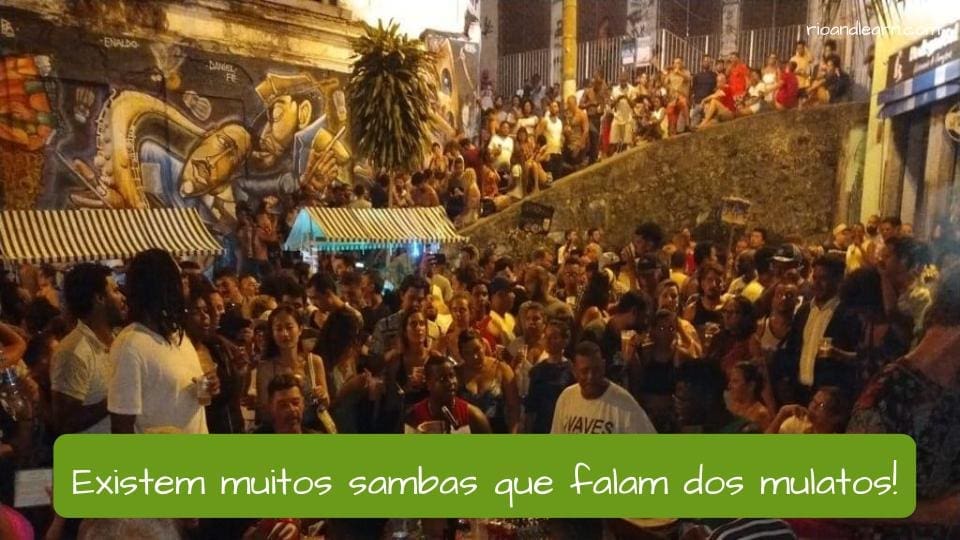
Let’s check out this song called Brasil Mulato, by Martinho da Vila, and let’s analyze the lyrics!
| Pretinha, procure um branco | Black girl, look for a white guy |
| Porque é hora de completa integração | ‘Cause it’s time for full integration |
| Branquinha, namore um preto | White girl, date a black guy |
| Faça com ele a sua miscigenação | Make your miscegenation with him |
| Neguinho, vá pra escola | Black boy, go to school |
| Ame esta terra | Love this land |
| Esqueça a guerra | Forget the war |
| E abrace o samba | And embrace the samba |
| Que será lindo o meu Brasil de amanhã | That my Brazil of tomorrow will be beautiful |
| Mulato forte, pulso firme e mente sã | Strong mulatto, steady wrist and sound mind |
| Quero ver madame na escola de samba sambando | I want to see madam at the samba school dancing |
| Quero ver fraternidade | I want to see fraternity |
| Todo mundo se ajudando | Everyone helping each other |
| Não quero ninguém parado | I don’t want anyone standing still |
| Todo mundo trabalhando | Everyone working |
| Que ninguém vá a macumba fazer feitiçaria | Let no one go to macumba to do sorcery |
| Vá rezando minha gente a oração de todo dia | Go praying, my people, the prayer of every day |
| Mentalidade vai mudar de fato | Mindset will change indeed |
| O meu Brasil então será mulato | My Brazil will then be mulatto |
If you want to get to know more about the impact of samba, you can always come with us to the epicenter of samba in Rio, Pedra do Sal, in our RioLIVE! activity.
Mulatto and Brazilian Mixed-Races
In Brazil, there is a great deal of miscegenation, so mulatto is not the only term related to Brazilian mixed-race identities. As we saw, mulatto refers to a mix of white and Black ancestry, but there are other groups as well, such as caboclos (white and Indigenous) and cafuzos (Black and Indigenous). In Brazil, these mixtures are often included in the category pardos. However, not all mixed-race people in Brazil are classified as pardo. People of mixed ancestry involving Asian heritage are officially included in the ethnic category amarelos (yellow), which also includes people of full Asian ancestry.
Brazil is a country of mixture. Miscegenation is widespread, and even people who do not appear mixed may have mixed ancestry.
Portuguese Vocabulary for Mulatto People
Let’s see some Portuguese vocabulary we learned to understand mulatto ancestry:
And that was all about the Mulatto people! We’ll see each other on our next Dica! If you want to learn about Brazil and the Portuguese language, subscribe at A Dica do Dia or follow us on Facebook for more information.
See you then folks!
Click on the links below to see more related Dicas
The Brazilian Caipira
The Sertanejo People
The Caiçara People

Online Academic Coordinator at Rio & Learn Portuguese School.
Experienced educational coordinator and teacher since 2007, adept in curriculum development, creating physical and digital educational materials, and leveraging online platforms to enhance learning outcomes
PakarPBN
A Private Blog Network (PBN) is a collection of websites that are controlled by a single individual or organization and used primarily to build backlinks to a “money site” in order to influence its ranking in search engines such as Google. The core idea behind a PBN is based on the importance of backlinks in Google’s ranking algorithm. Since Google views backlinks as signals of authority and trust, some website owners attempt to artificially create these signals through a controlled network of sites.
In a typical PBN setup, the owner acquires expired or aged domains that already have existing authority, backlinks, and history. These domains are rebuilt with new content and hosted separately, often using different IP addresses, hosting providers, themes, and ownership details to make them appear unrelated. Within the content published on these sites, links are strategically placed that point to the main website the owner wants to rank higher. By doing this, the owner attempts to pass link equity (also known as “link juice”) from the PBN sites to the target website.
The purpose of a PBN is to give the impression that the target website is naturally earning links from multiple independent sources. If done effectively, this can temporarily improve keyword rankings, increase organic visibility, and drive more traffic from search results.