
Sport Club do Recife is one of the great football symbols of Pernambuco.
Founded in Recife in 1905, Sport carries more than a century of history, major national titles, fierce local rivalries, and one of the strongest fan cultures in northeastern Brazil. Known for its red-and-black colors, lion mascot, and historic home at Ilha do Retiro, the club is closely tied to Recife football and the pride of the Brazilian Northeast.
For anyone exploring Brazilian football beyond Rio de Janeiro and São Paulo, Sport Club do Recife is an essential name. Its story begins with the arrival of football in Pernambuco and continues through generations of supporters, matchday traditions, unforgettable titles, and debates that still animate Brazilian football today.
Sport Club do Recife was founded on May 13, 1905, by Guilherme de Aquino Fonseca. He had studied in England, where football was already becoming popular, and brought that influence back to Pernambuco.
Sport is considered the first football club in Pernambuco, giving it a special place in the state’s football history. At the start of the 20th century, Recife was changing and opening itself to new cultural influences. Football was still new in Brazil, far from the national obsession it would become, and Sport emerged as one of the central clubs in the development of the game in the Northeast.
More than a century later, the players, competitions, and generations have changed, but Sport’s red-and-black identity remains one of the clearest symbols of football in Recife.
The Colors, Badge, and Rubro-Negro Identity
Sport’s colors are red and black. In Brazil, a team with these colors is often called rubro-negro. For Sport fans, this word is a direct part of the club’s identity.
The red brings intensity and passion. The black brings strength and tradition. Together, they create one of the most recognizable visual identities in Brazilian football.

The club’s badge carries the initials SCR and the lion, a symbol linked to a trophy won during a 1919 excursion to Belém. The image became one of Sport’s clearest signs of strength and leadership.
The badge appears on shirts, flags, walls, stickers, and tattoos. In Brazilian football, the club crest is one of the most visible signs of belonging.
The Sport Club do Recife Jersey
The Sport Club do Recife jersey is one of the club’s most visible symbols. The designs change over time, but the red-and-black identity stays the same.
In Brazil, football jerseys are worn far beyond the stadium. People wear them to the supermarket, the beach, barbecues, school events, and casual meetings with friends. A jersey signals which club a person supports before any conversation starts.
There is also a generational element. Children, parents, and grandparents often support the same club. A new Sport jersey can sit beside an older model from another era, each one connected to different players, matches, and memories.

Leão da Ilha: The Lion of the Island
Sport’s most famous nickname is Leão da Ilha, the Lion of the Island. The “island” refers to Ilha do Retiro, the area connected with the club’s stadium and home.
The lion fits Sport’s image because it conjures images of courage, strength, pride, and resistance. In Recife, it is not just a mascot. It is part of how fans describe the club and its personality.
The lion appears in club imagery, fan language, flags, and matchday culture. It gives Sport a clear identity: brave, intense, and difficult to ignore.
The nickname also reflects the club’s self-image within Brazilian football. Sport supporters often see the team as a force from Pernambuco capable of facing clubs from any part of Brazil.
The nickname Leão da Ilha combines Sport’s lion mascot with Ilha do Retiro, the neighborhood where the club’s historic stadium is located.
For many visitors, the name can be slightly confusing, as Recife is known as a city of rivers, bridges, and islands, where urban development expanded across waterways over the centuries.
Although Ilha do Retiro is now fully integrated into the urban landscape, the neighborhood’s name preserves this geographical heritage, making the Lion of the Island a symbol of both Sport Club do Recife and the city’s unique relationship with its islands.
Ilha do Retiro: Sport’s Home in Recife
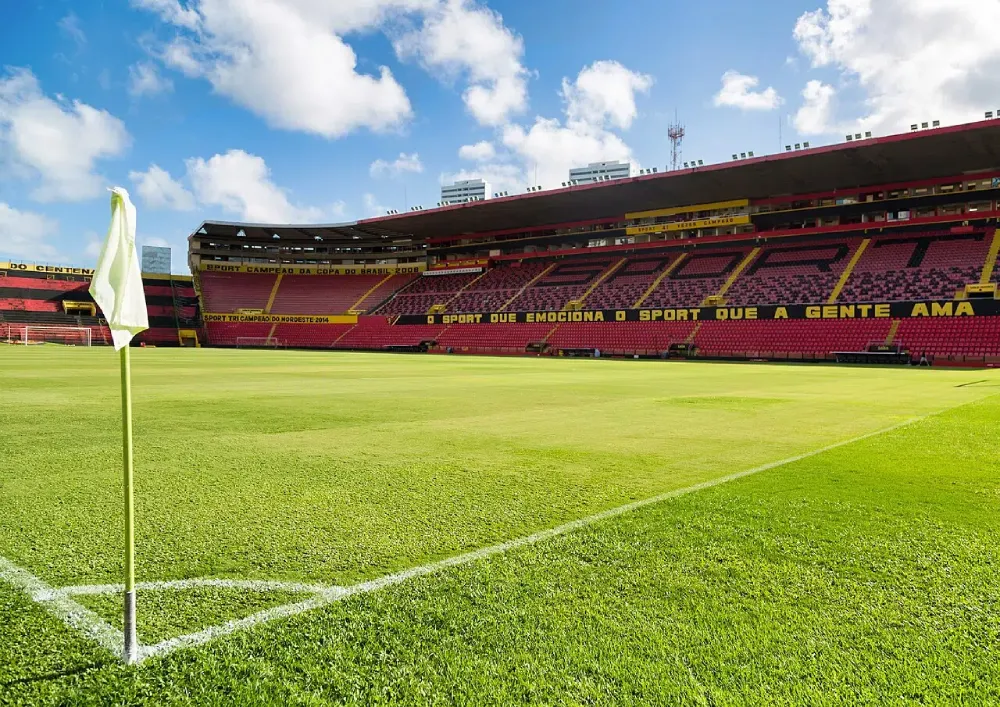
Sport plays at Ilha do Retiro, officially named Estádio Adelmar da Costa Carvalho. Opened in 1937, Ilha do Retiro is Sport’s historic home and one of Recife’s most important football landmarks. The stadium also hosted a match during the 1950 FIFA World Cup.
A match at Ilha do Retiro is a strong part of Recife football culture. Fans arrive in red and black. Vendors sell snacks and drinks. Friends meet outside the stadium. Families walk together. People discuss the lineup, criticize the referee, and remember old victories.
Inside the stadium, the crowd becomes part of the match. Every attack creates noise. Every mistake creates tension. Every goal turns the stands into a release of energy.
For travelers interested in a football arena in Recife, Brazil, Ilha do Retiro is one of the most meaningful places to know. It connects sport, city life, local pride, and the emotional culture of Brazilian football.

Major Titles and Historic Achievements
Sport Club do Recife has a long history of titles and memorable campaigns. The club has won many Campeonato Pernambucano titles, proving its strength within the state, and has also achieved major national success.
The most important achievements in the club’s history include the 1987 Campeonato Brasileiro, the 2008 Copa do Brasil, the 1990 Campeonato Brasileiro Série B, and Copa do Nordeste titles in 1994, 2000, and 2014.
Brazilian football is organized across several levels. Clubs compete locally, regionally, nationally, and sometimes internationally. For Sport, each major title strengthens its position as one of the most important clubs in northeastern Brazil.
The 1987 Brazilian Championship Story
The 1987 Brazilian Championship is one of the most famous and debated stories in Brazilian football.
That year’s national competition became controversial because of disagreements over format, organization, and recognition. Flamengo also claims the title from that season, creating one of the longest-running debates in Brazilian football history.
For Sport Club do Recife and its supporters, 1987 is a proud and official part of the club’s history. The club considers itself Brazilian champion, and this title remains central to the way Sport fans talk about their team.
The controversy shows how strongly football history is debated in Brazil. Titles are not only recorded in trophy rooms. They are discussed through federation decisions, legal arguments, newspaper archives, television debates, and conversations between fans.
Ask a Sport fan and a Flamengo fan about 1987, and the answers will be very different.
The 2008 Copa do Brasil
In 2008, Sport Club do Recife won the Copa do Brasil, one of the most important knockout tournaments. The final against Corinthians became one of the greatest moments in Sport’s history.
After losing the first leg in São Paulo, Sport returned to Recife needing a strong result at Ilha do Retiro. In front of its supporters, Sport beat Corinthians 2–0 and lifted the trophy.
For Pernambuco football, it was a major national statement. A club from Recife defeated one of Brazil’s biggest teams in a national final, with the decisive match played at Ilha do Retiro.
The 2008 title remains one of the clearest examples of Sport’s ability to compete with clubs from Brazil’s largest football centers.
Sport Club do Recife in the Libertadores
Winning the Copa do Brasil gave Sport a place in the Copa Libertadores, South America’s most famous club competition.
For Brazilian clubs, the Libertadores is a major stage. It brings international matches, difficult away games, pressure, and the chance to face major clubs from across the continent.
For Sport, the Libertadores meant international nights at Ilha do Retiro and a chance to face clubs from across South America. In the 2009 tournament, the team reached the round of 16, where it was eliminated by Palmeiras on penalties after two 1–0 results: Palmeiras won the first match in São Paulo, and Sport won the return match in Recife. Even without a deep run, the campaign remains part of the club’s modern history because it followed directly from the 2008 Copa do Brasil title.

In Recife, Sport’s biggest rivalries are with Náutico and Santa Cruz. These matches are among the most important sporting events in Pernambuco.
The rivalry between Sport and Náutico is known as the Clássico dos Clássicos, one of the oldest and most traditional derbies in Brazilian football. When these two clubs meet, the atmosphere is tense, historic, and full of local pride.
Sport’s rivalry with Santa Cruz is also huge. This derby is known as the Clássico das Multidões, the Classic of the Crowds. The name reflects the size of the fanbases and the intensity of Recife football.
These rivalries shape football life in the city. Families, neighborhoods, workplaces, and friend groups often include supporters of different Recife clubs. Sport, Náutico, and Santa Cruz create a local football triangle that gives Pernambuco football much of its character.
Sport Legends and Idols
Sport Club do Recife has produced and celebrated many important players, but a few names stand out because of what they gave to the club: titles, loyalty, goals, leadership, or a lasting place in the memory of the fans.
- Magrão: One of the greatest idols in Sport’s history, Magrão became a symbol of loyalty and leadership at Ilha do Retiro. The goalkeeper played more than 700 matches for the club and was part of major campaigns, including the 2008 Copa do Brasil and the 2014 Copa do Nordeste. For many Sport fans, he represents the modern image of dedication to the red-and-black shirt.
- Durval: A respected defender and captain figure, Durval was one of the leaders of Sport’s successful modern era. He was part of the team that won the 2008 Copa do Brasil and became known for his strength, consistency, and connection with the club. His long relationship with Sport made him one of the most respected names among the rubro-negro crowd.
- : One of the most loved attacking players in Sport’s history, Leonardo is remembered for his dribbling, goals, and joyful style of play. Sport’s official site describes him as one of the greatest players ever to wear the club’s shirt. He became especially important during the 1990s and remains one of the names most strongly associated with affection from Sport supporters.
- Juninho Pernambucano: Before becoming famous around the world for his free kicks, Juninho Pernambucano began his professional journey at Sport. He played for the club in the 1990s and was part of the team that won the Campeonato Pernambucano and Copa do Nordeste in 1994. His later success at Vasco, Lyon, and the Brazilian national team makes his Sport connection even more important.
- Ademir de Menezes: Ademir began his football career at Sport before becoming one of the great names of Brazilian football. He played in the club’s youth categories, reached the professional team, and helped Sport win the 1941 Campeonato Pernambucano unbeaten. His later national fame gives Sport a direct connection to one of Brazil’s historic football figures.
- Joelinton: One of the most successful players developed by Sport Club do Recife in the 21st century, Joelinton came through the club’s youth academy after growing up in the interior of Pernambuco. He made his professional debut for Sport in 2014 and quickly attracted attention for his physical strength, versatility, and attacking talent. At Newcastle, Joelinton reinvented himself as a dynamic midfielder and became one of the Premier League’s most respected players. His rise from Sport’s academy to the Brazilian national team remains one of the club’s most notable modern success stories.

Sport and the Pride of the Northeast
Sport Club do Recife is important not only because of what it has won, but because of what it represents.
Brazil is a huge country, and football often reflects regional identity. The Northeast has its own culture, accents, rhythms, foods, festivals, landscapes, and history. Pernambuco is known for frevo, maracatu, Carnival, poetry, beaches, street culture, and a powerful sense of local pride.
Sport is one of the football expressions of that identity.
When fans call Sport one of the great clubs of the Northeast, they are also saying that Brazilian football does not belong only to Rio de Janeiro, São Paulo, Minas Gerais, or Rio Grande do Sul. Recife has its own football power. Pernambuco has its own voice. The Northeast has its own giants.
Supporting Sport can become a way of defending local pride. The club represents Recife’s history, tradition, titles, rivalries, and football culture.
For foreign visitors, this is one of the most interesting parts of discovering Brazil. Every region has a different football flavor. Football in Recife does not feel exactly like football in Rio. Football in Rio does not feel exactly like football in São Paulo. Each city adds its own accent to the game.
More Than Ninety Minutes
Sport Club do Recife gives visitors and football fans a direct path into Recife culture.
Through one club, you discover Pernambuco pride, local rivalries, stadium culture, family tradition, and the emotional force of a red-and-black jersey. You also see how football in Brazil goes far beyond checking the result, reading Sport Club do Recife Soccerway statistics, or looking up the next match on the official site.
Sport connects football with language, identity, memory, humor, suffering, and celebration. It shows how a city can express itself through a club.
To know Sport is to know more about Recife. To know Recife is to know more about Brazil. And to learn Portuguese is to get closer to the jokes, matchday conversations, arguments, celebrations, and stories people tell long after the final whistle.
In Recife, the Lion is still roaring.
Click on the links below to see more related Dicas
Recife
Olinda
Football in Portuguese
Brazilian Northeast

SEO Content Specialist at Rio & Learn Portuguese School. A native English speaker who arrived in Brazil six months ago and quickly fell in love with the country, Tom focuses exclusively on Brazil-focused content. He combines data-driven keyword research with careful fact-checking in collaboration with Rio & Learn’s Brazilian teachers.
PakarPBN
A Private Blog Network (PBN) is a collection of websites that are controlled by a single individual or organization and used primarily to build backlinks to a “money site” in order to influence its ranking in search engines such as Google. The core idea behind a PBN is based on the importance of backlinks in Google’s ranking algorithm. Since Google views backlinks as signals of authority and trust, some website owners attempt to artificially create these signals through a controlled network of sites.
In a typical PBN setup, the owner acquires expired or aged domains that already have existing authority, backlinks, and history. These domains are rebuilt with new content and hosted separately, often using different IP addresses, hosting providers, themes, and ownership details to make them appear unrelated. Within the content published on these sites, links are strategically placed that point to the main website the owner wants to rank higher. By doing this, the owner attempts to pass link equity (also known as “link juice”) from the PBN sites to the target website.
The purpose of a PBN is to give the impression that the target website is naturally earning links from multiple independent sources. If done effectively, this can temporarily improve keyword rankings, increase organic visibility, and drive more traffic from search results.